
Chaudière-Appalaches
La plupart des premiers Acadiens de la région sont des réfugiés de l’Isle Saint-Jean passés par Québec. En 1756, le sieur Michel-Jean Péan, seigneur de Livaudière, concède des terres à des familles. Certaines s’établissent à Saint-Charles-de-Bellechasse, et tout particulièrement dans le rang de l’Hêtrière. D’autres s’installent dans les deux premières concessions de Saint-Gervais : le 1er Rang et le 2e Rang. Cet endroit se nomme la Nouvelle-Cadie jusqu’à l’ouverture de la paroisse Saints-Gervais-et-Protais, en 1780. Jusqu’à 70 familles acadiennes comprenant plus de 500 personnes y sont recensées dans les vingt-cinq premières années d’existence de cette paroisse. Par contre, le seigneur de Livaudière est accusé d’exploiter ses censitaires. Nombre d’entre eux quittent Saint-Gervais pour aller s’établir ailleurs.
L’abbé François Boutin, vicaire de Saint-Georges de Beauce, est chargé de 11 missions de la Côte-Nord. Il est responsable de l’installation de plusieurs Acadiens de la Côte-Nord à Saint-Théophile, paroisse qu’ils fondent en 1886. Ces derniers passent de pêcheurs à cultivateurs. Cependant, peu d’entre eux demeurent dans cette localité, qui est plutôt un lieu de passage.
Plusieurs autres villages accueillent des Acadiens en Chaudière-Appalaches, soit Lotbinière, Leclercville, Sainte-Croix, Saint-Joseph-de-Beauce, Beaumont, Saint-Vallier et Saint-Michel.
Aujourd’hui, plusieurs familles issues des pionniers résident toujours dans la région. Nous y trouvons encore des Arsenault, Bourque, Cyr, Comeau, Doiron, Hébert, Lapierre, Poirier et Trahan.
Please click on a name in the list below to go directly to its designated section.
Saint-Jean-Port-Joli
Plaque honoring Joseph Thériault and Agnès Cormier
Place of interest
Côtes des Chênes, between residences 541 and 577.
Saint-Jean-Port-Jolie, Chaudière-Appalaches
The Joseph Thériault and Agnès Cormier plaque stands on the land where they settled in 1763. On June 12, 2010, some 250 years after Joseph and Agnès arrived in Quebec, their descendants and members of the Association des familles Thériault d'Amérique unveiled a plaque on their ancestral land in memory of these courageous ancestors.
A few steps away, to the southeast,
Joseph Thériault (ca. 1719–1765),
Agnès Cormier (1722–1798) and their
children, originally from the region of
Beaubassin, in Acadia, built a
house on this land that they had
received at the dealership on September 23
1763 It was the beginning of a new life.
for the members of this family who
had to leave everything behind
to avoid being deported like
many of their fellow citizens.
Text written or compiled by the Acadian Museum of Quebec.
La Durantaye
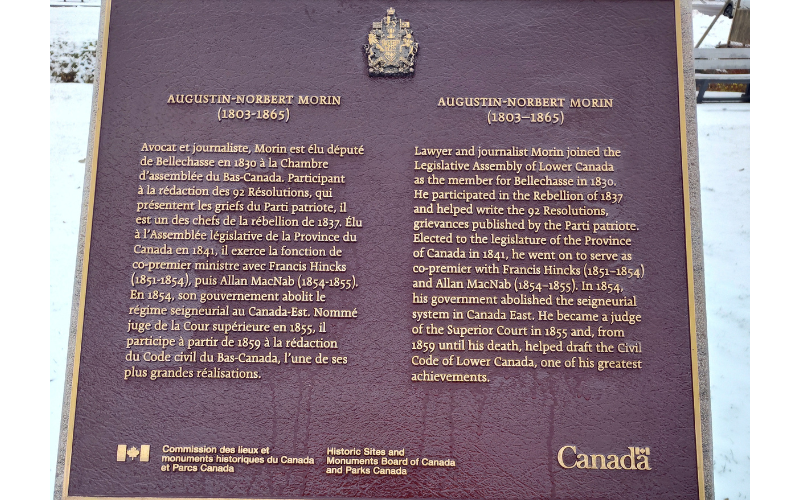
Augustin-Norbert Morin Square
Place of interest | Park by the pond, next to the church.
This plaque commemorates Augustin-Norbert Morin, lawyer, journalist, politician, and joint premier of the United Province of Canada from 1851 to 1855. He was born in La Durantaye (formerly the parish of Saint-Michel-de-Bellechasse) on October 13, 1803. His Acadian ancestors were Pierre Morin dit Boucher and Marie Martin. They were originally from Port-Royal and later moved to Beaubassin.
The plaque was created by the Bellechasse Historical Society in collaboration with the Association des Morin d’Amérique and the municipality of La Durantaye. It replaces an older plaque unveiled in 1942, which has since disappeared, commemorating the fact that the Honorable Augustin-Norbert Morin was born in the house that stood at 95, 5e rang in La Durantaye.
On September 10, 2000, during a special commemorative day, the plaque was unveiled under the honorary presidency of François Morin, president of the Morins of America, and Conrad Paré, president of the Bellechasse Historical Society.
More than 200 people attended the activities organized for the occasion, including a concert and a mass. Gaston Deschênes, historian and president of the Héritage de la Côte-du-Sud foundation, gave a lecture on the Patriots during the time of Augustin-Norbert Morin and on the unrest of 1837–1838, and Jean-Louis Morin, historian, gave a speech on the life and career of Augustin-Norbert Morin. Guests of honor included: Claude Lachance, Member of the National Assembly for Bellechasse; Charles-Eugène Blanchet, Prefect of the Bellechasse RCM; Andrée Couillard-Després, Mayor of La Durantaye; André Gaulin, former Member of the National Assembly for Taschereau; Father Laurent Audet, parish priest; Paul Beaudoin, Cultural Officer for the Bellechasse RCM; and many others.
The text on the commemorative plaque reads as follows:
The Bellechasse Historical Society, in collaboration with the Association des Morin d'Amérique Inc., recalls that on October 13, 1803, the Honorable Augustin-Norbert Morin, lawyer, journalist, doctor of law, and Superior Court judge, was born on his father's farm located on the 5th range of this municipality.
He drafted the 92 resolutions he presented to the Parliament in London in 1834 and served as representative for Bellechasse for 15 years.
He married Adèle Raymond in 1843 and died in Sainte-Adèle on July 27, 1865.
"May the memory of this great patriot live on forever."
September 2000
Text written or compiled by Jacques Gaudet and the Acadian Museum of Quebec.
© Municipality of La Durantaye
Source: Beaudoin, Paul, Au fil des ans magazine, Bellechasse Historical Society, vol. 12, no. 3, summer 2000
Breton, Fernand, Au fil des ans magazine, Bellechasse Historical Society, vol. 13, no. 1, winter 2001
Quebec Cultural Heritage Directory: www.patrimoine-culturel.gouv.qc.ca/
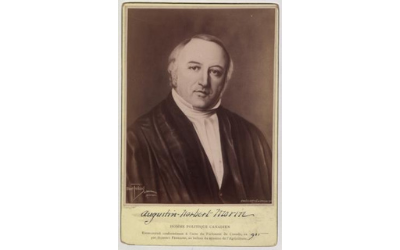
Augustin-Norbert Morin (1803–1865)
Personality
Augustin-Norbert Morin is a prominent figure in Quebec history. He was a lawyer, journalist, committed politician, member of parliament for most of his life, defender of the French language, judge, and ardent patriot.
His Acadian ancestors were Pierre Morin dit Boucher and Marie Martin, residents of Port-Royal and later Beaubassin. In 1686, the Morin family was related to about one-third of the population of Beaubassin. They were a well-to-do family and well-regarded by all. In 1688, following a scandal involving one of its members, the Morin family had its property confiscated without trial and was banished from Acadia. After spending some time in Baie-des-Chaleurs, Mont-Louis, and Quebec City, the family settled in the Bellechasse region.
The eldest son of Augustin Morin, a farmer, and Marianne Cottin dit Dugal, Augustin-Norbert was born on October 13, 1803, in La Durantaye (formerly the parish of Saint-Michel-de-Bellechasse), Quebec. On February 28, 1843, he married Adèle Raymond, daughter of Joseph Raymond, a merchant, and Louise Cartier.
Augustin-Norbert Morin entered the Quebec Seminary in 1815, where he distinguished himself through his outstanding academic achievements. In 1823, he moved to Montreal to study law and obtained his law degree in 1828.
In 1826, he founded the newspaper La Minerve. After Ludger Duvernay purchased the newspaper, he continued to contribute to it for many years on a variety of topics such as politics, justice, agriculture, education, etc.
On October 26, 1830, at the age of 27, he was elected representative for Bellechasse and made a remarkable entrance into Parliament. His political career lasted 25 years.
In 1834, he drafted 92 resolutions outlining the grievances and identity claims of Lower Canada (Quebec). He joined Denis-Benjamin Viger, agent of the Lower Canada House of Assembly in London, to present the province's petitions to the Parliament of the United Kingdom.
In 1837, he actively participated in the Patriotes rebellion (1837–1838). Arrested on November 15, 1837, he was released on bail three days later. In October 1839, he was imprisoned again for a week.
On October 15, 1842, he was appointed Commissioner of Crown Lands and used his influence to reform agriculture. He purchased the first lands granted in Abercrombie Township (Laurentians), where he built a house, sawmills, and a mill, thereby contributing to the development of the region. He was one of the key figures behind the first true colonization enterprise in the Pays-d'en-haut and the founder of Sainte-Adèle (named in honor of his wife), Morin-Heights, and Val-Morin.
A staunch advocate of education accessible to all, in 1845 he drafted the law establishing autonomous school boards reporting directly to the Superintendent of Public Instruction. This turning point in education laid the foundation for Quebec's traditional school system. From that point on, school enrollment and literacy rates rose steadily.
An early member of the Association Saint-Jean-Baptiste, founded by his friend Ludger Duvernay, he became its fourth president in 1846.
Successively representative for Bellechasse, Nicolet, Saguenay, Terrebonne, and Chicoutimi-Tadoussac, he presided over the Legislative Assembly from 1848 to 1851 and revised its code of procedures. He was “joint” prime minister of the Province of Canada (with Sir Francis Hincks and then Sir Allan MacNab) from 1851 to 1855, when he retired to accept a position as judge.
He contributed to the founding of Laval University in 1852 and became the first dean of the law faculty. In February 2013, Laval University's law faculty announced the creation of the Augustin-Norbert Morin Excellence Scholarship, which aims to recruit the best doctoral students in law. The scholarship is offered to one student at a rate of $15,000 per year for three years.
In 1854, he succeeded in abolishing the seigneurial system, which no longer met the growing needs of Quebec society.
In January 1855, he left politics and was appointed judge of the Superior Court. In 1859, he was a member of the commission responsible for codifying Lower Canada's first Civil Code. He became the editor of the new Civil Code, which came into force on August 1, 1866.
A true jack-of-all-trades who delved deeply into every subject he studied and foresaw the short- and long-term consequences of legislative measures, "Augustin-Norbert Morin is undoubtedly a major figure of 19th-century Canada. A fervent patriot, he was known for his proverbial integrity, which no opponent ever disputed. [Jean-Marc Paradis]
He died in Sainte-Adèle on July 27, 1865, and was buried in Notre-Dame-du-Rosaire Church in Saint-Hyacinthe on July 30, 1865.
Commemorative plaques in La Durantaye, Quebec City, Ste-Adèle, and St-Hyacinthe recall Augustin-Norbert Morin's significant contribution to Quebec society.
In fact, his name can be found in the toponymy of several places in Quebec:
- Laurentian region: municipalities of Ste-Adèle, Val-Morin, and Morin Heights; Morin Township; Saint-Norbert Parish in Val-Morin; Augustin-Norbert Morin High School in Ste-Adèle; Norbert-Morin Boulevard in Ste-Agathe-des-Monts.
- Montérégie region: Augustin-Norbert Morin Park and Morin Street in St-Hyacinthe.
- Chaudières-Appalaches region: Norbert-Morin Road in La Durantaye, Morin Hamlet in St-Raphaël.
- Eastern Townships region: Juge Morin Street in Sherbrooke.
Text written or compiled by Jacques Gaudet and the Acadian Museum of Quebec.
© Pierre-Georges Roy, Judges of the Province of Quebec, 1933
Source: PARADIS, Jean-Marc, Morin Augustin-Norbert. Library and Archives Canada. Dictionary of Canadian Biography: www.biographi.ca
PARADIS, Jean-Marc, Augustin-Norbert Morin, 1803-1865, published by Septentrion, Quebec City, 2005, 312 pages
Quebec National Assembly. History: Dictionary of Quebec Parliamentarians from 1792 to the Present: www.assnat.qc.ca/
Bellechasse Historical Society. Newsletter Au fil des ans, vol. 12, no. 3, summer 2000
Website Les Patriotes de 1837@1838: www.1837.qc.ca
Municipality of Sainte-Adèle: www.ville.sainte-adele.qc.ca/page-histoire.php
Civil status records and church registers of Quebec (digitized Drouin Collection)
Genealogical Dictionary of Acadian Families, Center for Acadian Studies, University of Moncton, 1999, pages 1220-1224
Augustin-Norbert Morin (1803–1865)
Saint-Charles-de-Bellechasse
Plaque Honoring the Acadians of Saint John Island
Place of interest
Saint-Charles-Borromée Cemetery
, 2817 Royal Avenue.
This plaque, erected in 1999, pays tribute to the Acadians who fled deportation. In 1758, 56 of them were buried in Saint-Charles-de-Bellechasse, several years before the neighboring parish of Saint-Gervais was established.
In memory of the Acadians
from Saint John's Island (PEI)
that our parish welcomed at
end of their flight from the
threat of deportation and also in memory of the 56 among them
who were buried in this cemetery in 1758, victims of poverty
encountered on the road to exile.
Text written or compiled by the Acadian Museum of Quebec.
© Bellechasse Historical Society
Saint-Gervais
Most of the first Acadians in St-Gervais were refugees from Île-Saint-Jean (now Prince Edward Island). In 1756, Sieur Michel-Jean Péan, seigneur of Livaudière, granted land to seven Acadian refugee families, then to thirteen other families, including some Acadians of German origin. These were the first two concessions in St-Gervais: the First and Second Cadie (1st and 2nd ranges).
At first, this place was called "Nouvelle-Cadie." This name appears in notarial contracts from that period until the opening of the parish of Saints-Gervais-et-Protais in 1780. The latter, canonically established in 1832 and civilly in 1835, was the origin of Saint-Gervais, founded by Acadians.
Up to seventy Acadian families comprising more than 500 people are recorded in the first 25 years of this parish's existence: Arsenault, Barriau, Babineau, Boudrot, Cyr, Comeau, Doiron, Gauterot, Hébert, Landry, Poirier, Savoie, Trahan, Vincent...
The Lord of Livaudière is accused of exploiting his Acadian tenants. Living conditions are difficult for them. After the capture of Quebec by the English in 1759, the Acadians of St-Gervais are left to fend for themselves, and the effects of the war are painful in the Bellechasse region. Many Acadians leave St-Gervais to settle in other places where they can better provide for their children's future.
Nevertheless, a good number of Acadians remained on their land and contributed to the development of the municipality, which became prosperous and one of the most beautiful in the region.
This municipality is historically considered the mother parish of six colonization parishes south of its territory. Successive migrations mean that today we find descendants of Gervaisian stock all the way to the American lines.
Antonio Arsenault (1903–1977), an Acadian from St-Gervais, was a respected country priest. He left his mark on Saint-Sévérin de Beauce, where he lived from 1962 to 1984. Two films are dedicated to him: Journée d’un curé de campagne (A Day in the Life of a Country Priest), by director François Brault of the National Film Board of Canada, and Héritage de gloire (Legacy of Glory) by Benoît Lachance. Louise Chamberlan’s book, Antonio Arsenault (1903–1977). Un curé original (Antonio Arsenault (1903–1977): An Original Priest), provides a good description of this character.
Today, several families descended from Acadian pioneers still reside in St-Gervais. Acadian names can still be found there: Arsenault, Cyr, Comeau, Doiron, Hébert, Poirier, Trahan.
The memory of the Acadian pioneers of St-Gervais lives on in various ways:
- The blue, white, and red Acadian flag, marked with a yellow star, sits at the top of the coat of arms, which was unveiled on July 26, 1980. It symbolizes the Acadian people, co-founders of the municipality.
- The first and second rows are known as "La Première Cadie" and "La Deuxième Cadie."
- The elementary school is called "École de la Nouvelle-Cadie," and the municipal library is called "Bibliothèque Faubourg de la Cadie."
- The interpretive panel in the historic park, which tells the story of the Acadians' settlement.
- The procession chapel, located at the intersection of 1st Row and Main Street, is a heritage building. Built around 1817, based on a model reminiscent of the church in Grand-Pré, Nova Scotia, it was restored in 2003 and converted into an art center where local artists can exhibit their work.
Text written or compiled by Jacques Gaudet.
Source: Pierre-Maurice Hébert, Les Acadiens du Québec, Éditions de L’Écho, Montreal, 1994. Bona Arsenault, Histoire des Acadiens, updated edition by Pascal Alain, Éditions Fides, 2004. Louise Chamberland, Antonio Arsenault (1903-1977) Un curé original, Éditions L’Ardoise, Quebec City, 2002. Municipality of St-Gervais: www.saint-gervais.ca. Bellechasse Historical Society: www.shbellechasse.com/photographies.html
Plaque Honoring Acadian Pioneers
Place of interest
Promenade-des-Soeurs Historical Park
220 Principale Street, Saint-Gervais.
Located in the historic Promenade-des-Soeurs park, a fountain has been erected to pay tribute to the Acadian pioneers who settled in this area in 1756. They were joined a decade later, in 1766, by other families of deportees.
The monument was created by Alain Bourassa in 2005. On the edges, you can read: Tribute to the Acadians, the first settlers of Saint-Gervais.
In addition, six interpretive panels explain the history of the municipality. One of them, located near the parish's bicentennial monument, recounts the arrival and settlement of the Acadians.
Text written or compiled by Jacques Gaudet and the Acadian Museum of Quebec.
Source: Municipality of St-Gervais: www.saint-gervais.ca
Bellechasse Historical Society: www.shbellechasse.com
Sainte-Marie-de-Beauce
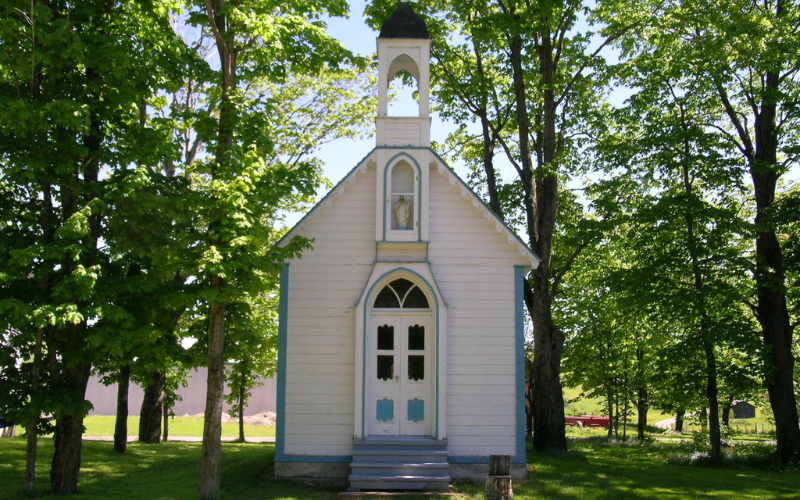
Hébert Chapel
Place of interest | 940 Saint-Gabriel South Road
The Hébert Chapel was built in 1835 by Louis Hébert, a carpenter, as a token of gratitude for a favor granted to Jean and Maria Hébert. Built in the neoclassical style, it is dedicated to Our Lady of Protection.
This private chapel, passed down through the generations, now belongs to another Jean Hébert, the builder's grandson.
Text written or compiled by the Acadian Museum of Quebec.
© Gabriel Hébert
Contact us
95 Port-Royal Avenue, Bonaventure, G0C 1E0
[email protected]
418-534-4000 | Toll-free: 1-833-920-3900
SCHEDULE
mardi au vendredi : 9 h à 12 h et 13 h à 16 h
dimanche : 13 h à 16 h

NEWSLETTER
Sign up to our newsletter now.
ABOUT US
Our purpose
Team
Career
Our partners
INFORMATION
News
Annual reports
Learn about Acadia
General policies
GROUP VISIT
School trip
Tour operator
CORPORATE
Room rental
Call for projects