
Quebec
Quebec City was a hub for Acadians. From 1756 to 1759, some 2,000 deportees took refuge there. However, the situation in Quebec City was critical: the city was overcrowded, food was scarce, and famine loomed. Unfortunately, disease struck, and more than 300 of them died of smallpox.
The story of the first group to arrive aboard the ship Pembroke is an interesting one. In December 1755, this ship left Annapolis Royal with 232 deportees on board, bound for North Carolina. Following a mutiny, they took control of the ship. They reached the Saint John River in January 1756 and spent the winter in the village of Sainte-Anne-des-Pays-Bas (Fredericton, New Brunswick). Some reached Quebec City in 1757.
In 1759, the British bombarded Quebec City, and the population was evacuated. Some of the Acadians took refuge in the surrounding countryside: Bellechasse, Beauce, Lotbinière, Charlevoix, and Portneuf. Many fought alongside the French during the Battle of the Plains of Abraham in 1759 and the Battle of Sainte-Foy in 1760.
Under Governor James Murray's policy, two groups of deportees from Massachusetts arrived in 1766, but most of them left Quebec for other regions. Between 1769 and 1770, they represented less than 6% of the population. This proportion remained roughly the same until the 1810s.
At the beginning of the 20th century, Acadians from the Maritimes, Gaspé Peninsula, and Magdalen Islands settled in Quebec City. Limoilou became the main Acadian neighborhood. Starting in 1918, a section of Beauport even took the name Petit Village des Acadiens (Little Acadian Village).
Please click on a name in the list below to go directly to its designated section.
Cité-Limoilou
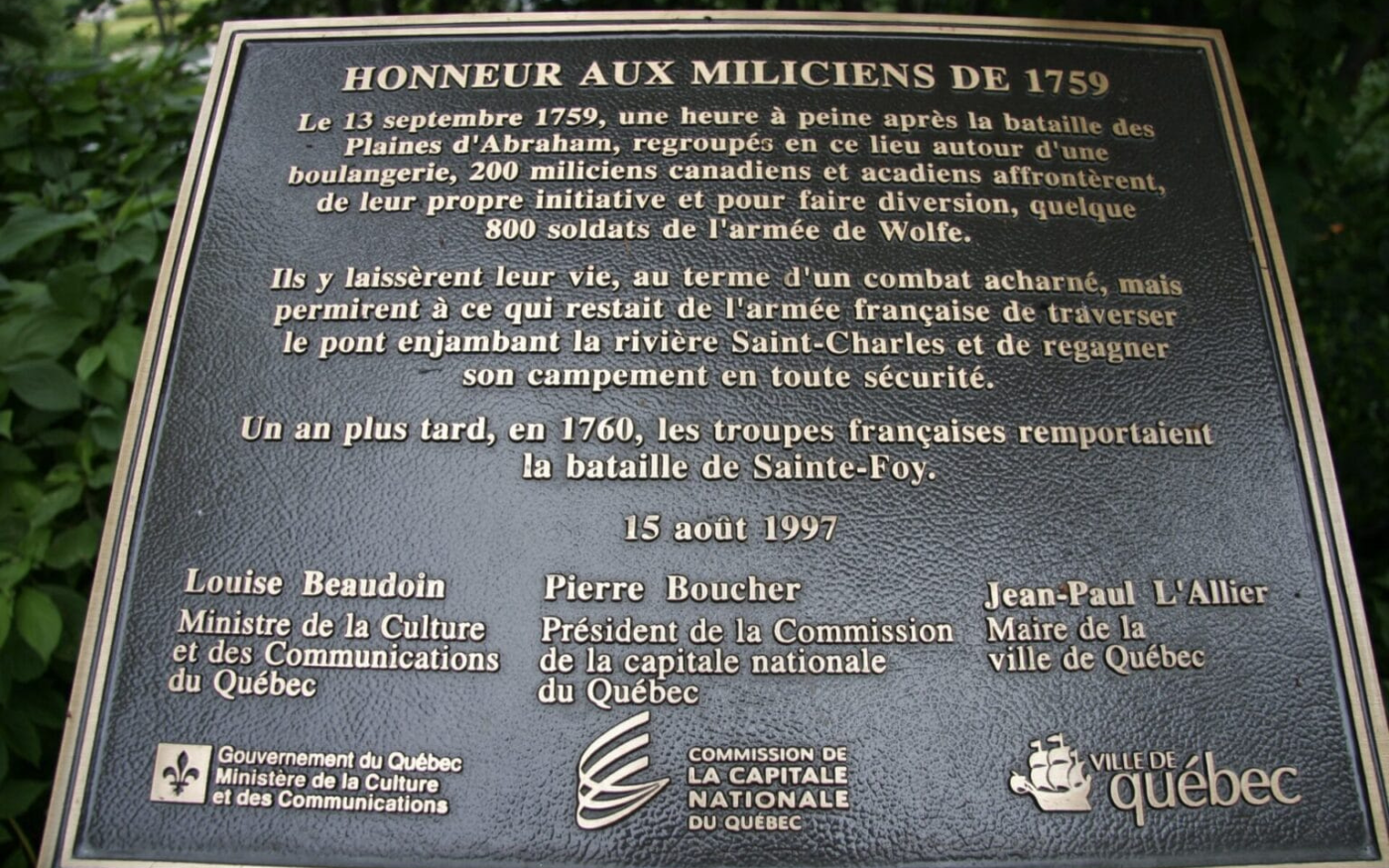
Honor to the militiamen of 1759
Place of interest
Saint-Vallier Street East, Quebec City
Commemorative plaque honoring the militiamen who sacrificed their lives to enable the French army to retreat and safely return to its camp at Beauport following the Battle of the Plains of Abraham. The text recalls this battle between French militiamen and Wolfe's British army, which resulted in a large number of casualties. The plaque was unveiled on August 15, 1997, during a ceremony attended by the Compagnie franche de la marine, members of the Chambly Militia, and the Les Voltigeurs de Québec regiment. The ceremony was followed by celebrations of Acadian National Day.
Honor to the militiamen of 1759
On September 13, 1759, barely an hour after the Battle of the Plains of Abraham, gathered at this location around a bakery, 200 Canadian militiamen and Acadian militiamen confronted, on their own initiative and as a diversion, some 800 soldiers from Wolfe's army. They lost their lives after a fierce battle, but they allowed what remained of the French army to cross the bridge over the Saint-Charles River and return safely to their camp. A year later, in 1760, French troops won the Battle of Sainte-Foy. Sainte-Foy. August 15, 1997
Text written or compiled by Jacques Gaudet and the Acadian Museum of Quebec
Sources: National Capital Commission : www.capitale.gouv.qc.ca
Coalition of Acadian Organizations in Quebec: www.acadiensduquebec.org/miliciens1759.html
© CCNQ, Patricia Brochu | Plaque honoring the militiamen of 1759
https://www.capitale.gouv.qc.ca/histoire-et-patrimoine/commemorations/plaque-honneur-aux-miliciens-de-1759/
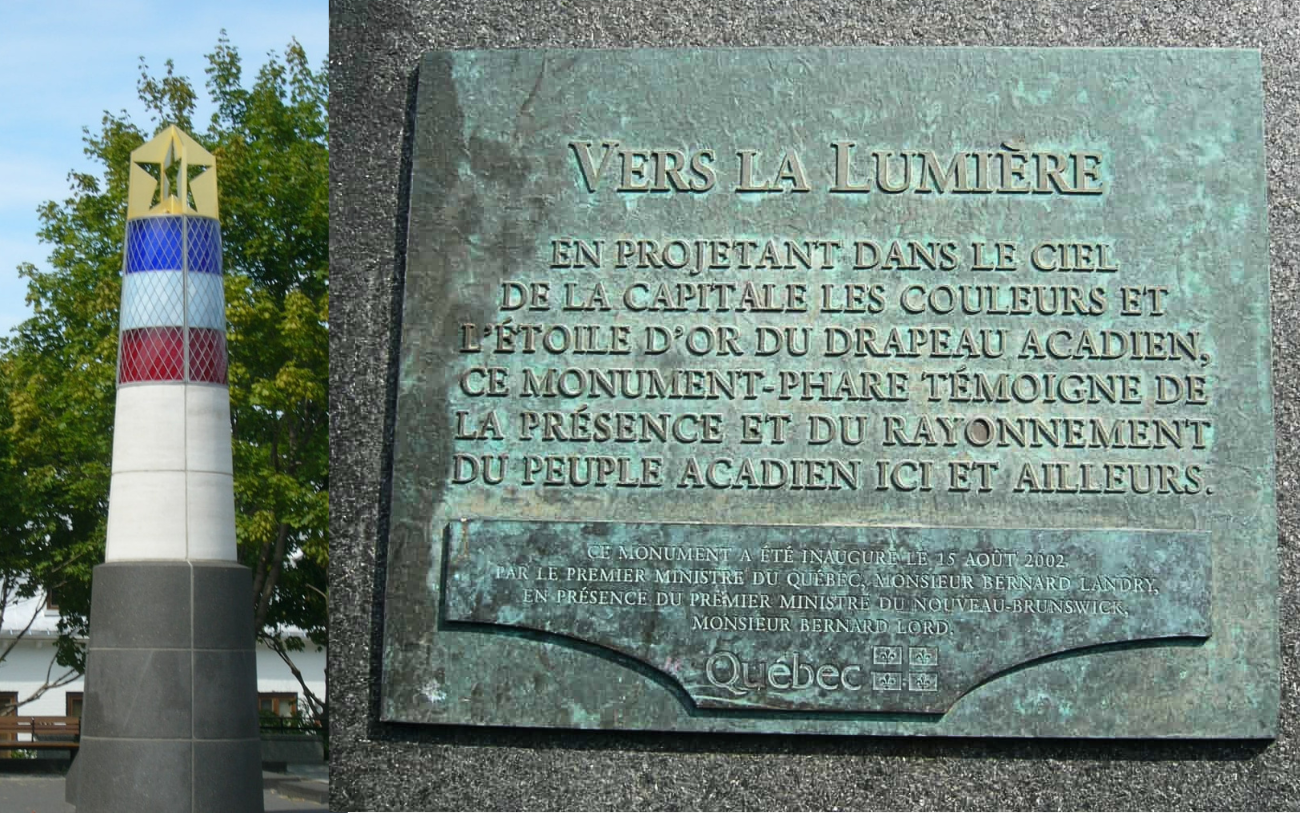
Acadian Monument in Quebec City
Place of interest
René-Lévesque Boulevard East, Quebec City
This monument was erected in 2002, on the initiative of the Quebec National Capital Commission in collaboration with Quebec City and the Acadian Association of the Quebec Region, to pay tribute to the Acadians and highlight the importance of Acadian heritage in the Quebec region.
The monument, entitled Vers la lumière (Towards the Light), is shaped like a lighthouse topped with the colors of the Acadian flag and a golden star that is illuminated at night. It symbolizes the predominant role that Acadians and their descendants have played in Quebec's history and recognizes the remarkable contribution of Acadians to the Quebec nation. A bronze commemorative plaque rests on a granite base and defines the meaning of the monument:
Towards the light
By projecting the colors and the golden star of the Acadian flag into the sky above the capital,
this landmark monument bears witness to the presence and influence of the Acadian people, here and elsewhere.
The monument was unveiled on August 15, 2002, by Quebec Premier Bernard Landry, in the presence of New Brunswick Premier Bernard Lord. The Minister responsible for La Francophonie in New Brunswick, Paul Robichaud, the Minister responsible for Canadian Intergovernmental Affairs and Minister responsible for Relations with Francophone and Acadian Communities, Jean-Pierre Charbonneau, the Minister responsible for the Capitale-Nationale region, Rosaire Bertrand, the representative of the Mayor of Quebec City, Jacques Joli-Coeur, the president of the Société nationale de l’Acadie, Euclide Chiasson, the president and CEO of the Commission de la capitale nationale du Québec, Pierre Boucher, and the president of the Association acadienne de la région de Québec, Rita Cormier de la Garde, also participated in the monument’s inauguration.
Nearly 800 people attended the event, which featured performances by the choir "Échos d'Arcadie," Acadian folklorist Linda Wedge, and brothers Patrice and Dominique Robichaud from the former group "Okoumé," originally from the Magdalen Islands.
The monument is located in a green space dedicated to Acadians. It is situated between René-Lévesque Boulevard East and Claire-Fontaine and Prévost streets, next to the Grand Théâtre de Québec and the Parc de l'Amérique-Française. The pedestrian walkway that crosses it is called the "Promenade des Acadiens."
Text written or compiled by Jacques Gaudet
Sources:
Quebec National Capital Commission www.capitale.gouv.qc.ca
Coalition of Acadian Organizations of Quebec www.acadiensduquebec.org/monumentquebec.html
© The Acadian Monument in Quebec City | Coalition of Acadian Organizations in Quebec
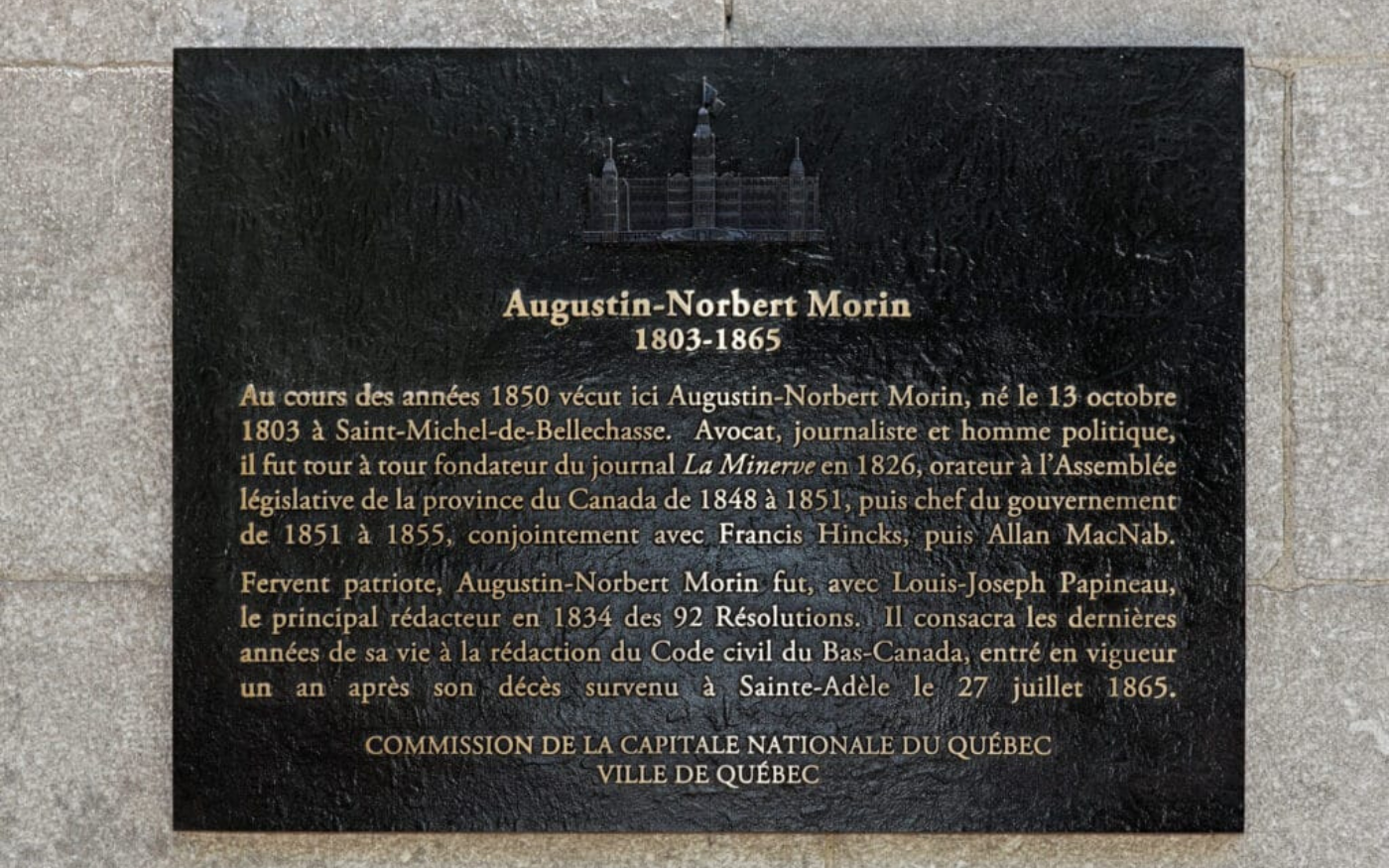
Augustin-Norbert Morin plaque
Place of interest
73 D’Auteuil Street, Quebec City
Plaque in memory of Augustin-Norbert Morin, lawyer, journalist, politician, and joint premier of the United Province of Canada from 1851 to 1855. He was born in La Durantaye (formerly the parish of Saint-Michel-de-Bellechasse) on October 13, 1803. His Acadian ancestors were Pierre Morin dit Boucher and Marie Martin, who first lived in Port-Royal and later in Beaubassin.
In 1856, Judge Augustin-Norbert Morin had a three-story stone house built according to plans by architect Charles Baillairgé. In 1860, merchant Thomas Gibb acquired the residence. In 1876, Amelia Torrance, Thomas Gibb's widow, moved in with her husband, Reverend William B. Clarke. The house, which was vacant in 1890, was sold the following year to Judge Adolphe-Basile Routhier. In 1920, the property was left to Angélique Routhier and sold the following year to notary Joseph-Gérard Verreault. In 1943, the building was divided into eight apartments according to plans by architect Charles-A. Jean. The house is part of the Old Quebec heritage site, listed as a UNESCO World Heritage Site.
The commemorative plaque is a joint project of the City of Quebec and the Quebec National Capital Commission. It is located on the façade of the house at 73 D’Auteuil Street in Quebec City.
The plaque was unveiled on May 28, 2009, in the presence of Denise Trudel, city councilor and member of the executive committee of Quebec City, and Jacques-Yvan Morin, former minister and great-grandnephew of Augustin-Norbert Morin.
The text on the commemorative plaque reads as follows:
Augustin-Norbert Morin
, 1803–1865
During the 1850s, Augustin-Norbert Morin, born on October 13, 1803, in Saint-Michel-de-Bellechasse, lived here. A lawyer, journalist, and politician, he was the founder of the newspaper La Minerve in 1826, a speaker in the Legislative Assembly of the Province of Canada from 1848 to 1851, and then head of government from 1851 to 1855, jointly with Francis Hincks and then Allan MacNab.
A fervent patriot, Augustin-Norbert Morin was, along with Louis-Joseph Papineau, the main author of the 92 Resolutions in 1834. He devoted the last years of his life to drafting the Civil Code of Lower Canada, which came into effect one year after his death in Sainte-Adèle on July 27, 1865.
QUEBEC NATIONAL CAPITAL COMMISSION
CITY OF QUEBEC
Text written or compiled by Jacques Gaudet and the Acadian Museum of Quebec.
Sources: National Capital Commission: www.capitale.gouv.qc.ca/
Quebec Cultural Heritage Directory: www.patrimoine-culturel.gouv.qc.ca/
© CCNQ, Paul Dionne | The plaque dedicated to Augustin-Norbert Morin
https://www.capitale.gouv.qc.ca/histoire-et-patrimoine/commemorations/plaque-a-augustin-norbert-morin/
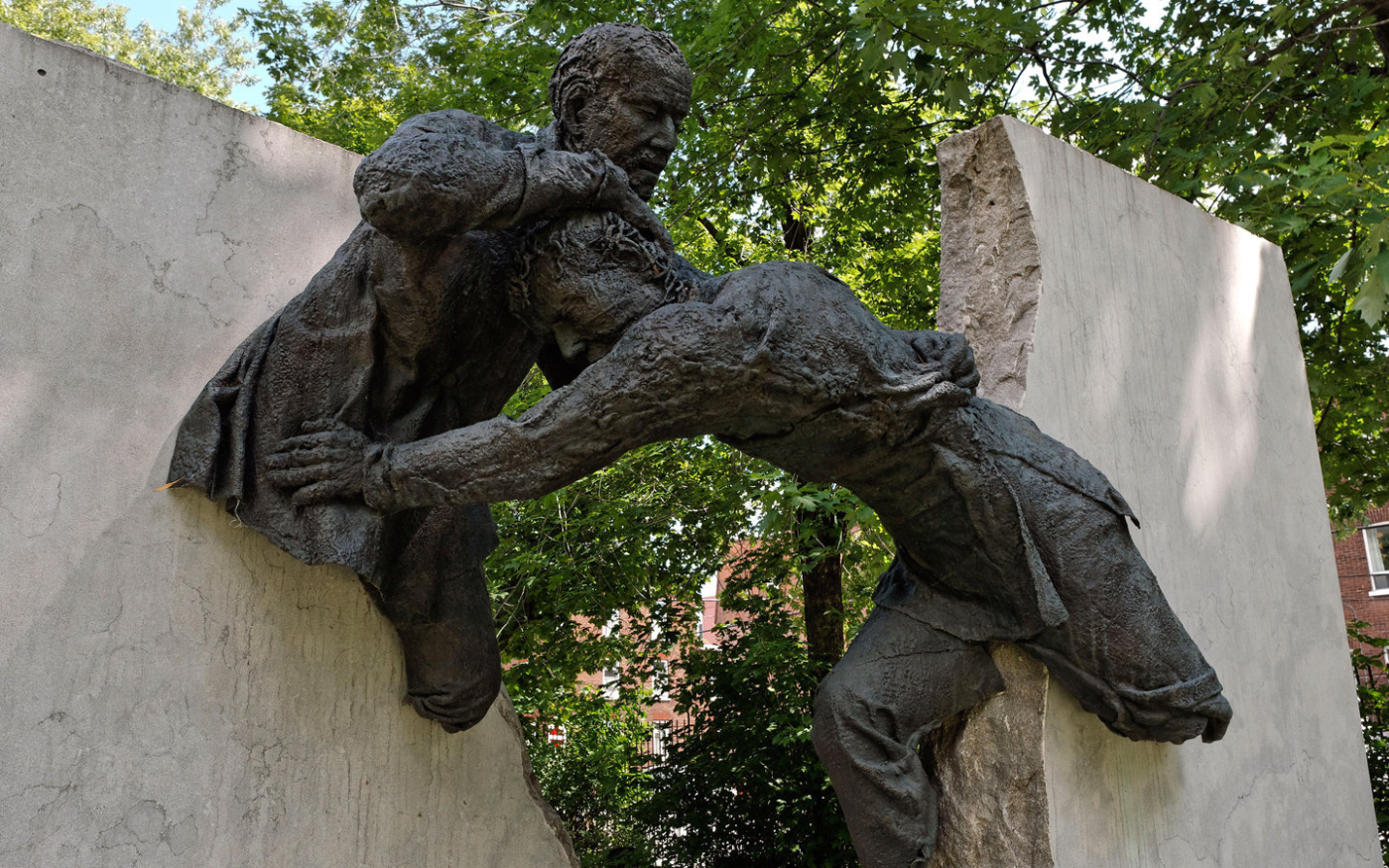
Sculptures by Louis-Philippe Hébert
Place of interest
Parliament Building
1045 Parliament Street, Quebec City
Eugène-Étienne Taché's masterpiece, the Parliament Building was constructed between 1877 and 1886. The building, consisting of four wings surrounding a square inner courtyard, is a veritable monument to the glory of the men and women who have marked the history of Quebec and French America. The 26 bronze statues on the façade represent some of the greatest figures in history: founders, explorers, military leaders, missionaries, politicians, and public administrators.
Starting in 1886, Louis-Philippe Hébert* created several of these sculptures, including those of Frontenac, Lord Elgin, Montcalm, Wolfe, Michel de Salaberry, and Lévis. His genius is also evident in four scenes:Allegories of Poetry and History, Allegories of Religion and the Fatherland, Fisherman with a Nigogue, andRest in the Forest.
Text written or compiled by the Acadian Museum of Quebec.
Seven Years' War Memorial
Place of interest
260 Langelier Boulevard, Quebec City
The memorial consists of a large sloping area surrounded by low stone walls. It evokes the mass graves in which the victims of this war, including civilians, were buried. A sculpture dominates the ensemble. It was inaugurated on October 11, 2001, under the presidency of Quebec Premier Bernard Landry. A commemorative event was held on September 13, 2009, in memory of the militiamen who defended New France during the War of Conquest. For the occasion, a text was engraved on one of the stones of the memorial.
Seven Years' War Memorial
Between 1755 and 1760, the Seven Years' War claimed more than 2,500 lives in Quebec City. Of of these, at least 1,058 were soldiers and sailors, mainly French, but also Canadians, Acadians, Native Americans, and British, entrusted to the care of the Augustinian Sisters at the General Hospital, succumbed to their wounds or illness.
In accordance with the custom of the time, they were buried in mass graves in and around this cemetery.
This memorial, dominated by Pascale Archambault's work Traversée sans retour (Journey of No Return), commemorates their names.
Text written or compiled by Jacques Gaudet and the Acadian Museum of Quebec
Source: National Capital Commission : www.capitale.gouv.qc.ca
Coalition of Acadian Organizations in Quebec: www.acadiensduquebec.org/miliciens1759.html
© The Seven Years' War Memorial | Quebec National Capital Commission
https://www.capitale.gouv.qc.ca/histoire-et-patrimoine/commemorations/memorial-de-la-guerre-de-sept-ans/
Jean Béliveau Monument
Place of interest
Place Jean-Béliveau on the ExpoCité site,
250 Wilfrid-Hamel Boulevard, Quebec City
This statue of Jean Béliveau, entitled "Breaking the Ice," was unveiled on November 21, 2018, at Place Jean-Béliveau on the ExpoCité site in Quebec City. Artist and sculptor Éric Lapointe created this work, which stands over eight meters tall and nine meters deep.
It is an anamorphosis, meaning that its appearance changes depending on the perspective. From many angles, the work appears abstract. However, when viewed from a specific spot, the silhouette of Jean Béliveau appears to the viewer. This spot is identified by a Quebec City Aces hockey puck located south of the statue.
Mr. Lapointe says he was inspired by the ice on the St. Lawrence River when choosing colors and depicting the movement of a hockey player skating forward.
This statue is part of a project involving the City of Quebec and the National Capital Commission to pay tribute to the defining moments in Quebec City's hockey history. Five periods will be represented in a commemorative walkway on the ExpoCité site. This statue of Jean Béliveau marks the era of the Quebec Aces, while the four following works will highlight, in turn, the Nordiques in the National Hockey League, the Nordiques when they were in the World Hockey Association, the Remparts, and the Bulldogs.
Text written or compiled by the Acadian Museum of Quebec
Charlesbourg
Napoleon-Alexandre Comeau Monument
Place of interest
Parc des Moulins, 8191 Zoo Avenue, Quebec City
This Napoleon-Alexandre Comeau monument is a replica of Godbout's monument.
The bas-relief scenes on the monument depict the hero's exploits: the capture of 57 salmon on July 9, 1874, the double shot by the marksman in a flock of ducks, the visit of the midwife preceded by the stork, and finally, the dramatic crossing of the ice on the St. Lawrence River in 1886.
A humble child of the North, he knew how to read with authority from the great book of nature while serving his people and his country.
Tribute from the Provencher Society of Natural History of Canada
Text written or compiled by the Acadian Museum of Quebec
Beauport
Little Acadian Village
Place of interest
Vieux-Moulin neighborhood, Beauport borough, Quebec City
The Petit Village des Acadiens is located in the Beauport borough of Quebec City. In its early days, it was bordered to the north by Chemin du Petit Village, to the east by Avenue D'Estimauville, to the south by Rue Évangéline, and to the west by Avenue Monseigneur Gosselin. The construction of Highway 40 in the late 1960s resulted in the boundaries of the Petit Village des Acadiens being moved to the area south of the highway.
Originally, this territory was part of the Village of Giffard, created in 1912, and the parish of Saint-Ignace-de-Loyola, established in 1914. There were no buildings until 1918, when the four Turbide brothers (Albert, Eusèbe, Samuel, and Stanislas), Acadians from the Magdalen Islands, settled there. Albert Turbide was elected councilor for District #6 of the Village of Giffard in February 1936.
Other Acadian families joined the ranks of the Petit Village des Acadiens in 1921, including Édouard Faullem, the Richards, the Jomphe family, the Chevarie family, the Chiasson family, and the Leblanc family. New streets quickly appeared, and in 1935, the Giffard municipal council named them Évangéline and L’Assomption (renamed Bouctouche in 2006 despite opposition from residents). Turbide Avenue was opened in 1948.
The Turbide brothers and their compatriots were responsible for numerous residential constructions and the development of this territory. In his souvenir album, Joseph-Albert Turbide lists 32 houses and 70 households occupied by Acadians and their descendants.
In 1946, to meet the growing needs of the school-age population in the area, a first classroom was opened in the home of Mr. Eusèbe Turbide. A second classroom was opened in 1951, and 1953 marked the construction of L'Assomption School, which had four classrooms. Today, the school's premises are used for preschool and daycare services for students at Marie-Renouard School.
The neighborhood flourished (280 families in 1956). Following efforts by residents, the Archbishop of Quebec issued a decree in February 1956 establishing a chapel (services provided by a priest) in a room at the new Marie-Renouard school. The Notre-Dame de l'Espérance parish was established five years later, in 1961.
The name "Petit Village des Acadiens" (Little Acadian Village) is commonly used in popular parlance and by local residents to refer to this neighborhood. The term "Faubourg des Acadiens" (Acadian Suburb) began to appear in more official documents in 1986.
In 2013, several descendants of the first Acadian families still live in the neighborhood, and many buildings constructed by the first Acadian families still exist, even if they have been converted or modernized. The Acadian presence is still visible in the place names: Évangéline Street, Turbide Avenue, Bouctouche Avenue (formerly Assomption Avenue), Évangéline Park, Sagouine Street, Évangéline Square, and the Évangéline Gardens.
Text written or compiled by Jacques Gaudet and the Acadian Museum of Quebec
Source: Joseph-Albert Turbide, Souvenir Album of the Little Acadian Village, Notre-Dame de l’Espérance Parish, 2011. Notre-Dame de l’Espérance 1961-1986, souvenir album Giffard Parish, souvenir album 1914-1959 Histoire de raconter, the Giffard neighborhood, Beauport borough, 2007 Quebec City, street name directory.
Acadian celebration
Event
320 Heritage Road
Since its founding,the Acadian Association of the Quebec City Region has celebrated Acadian National Day. Every year on August 15, Acadians remember their roots and celebrate their national holiday in style with a mass of gratitude and the raising of the Acadian flag, followed by a mini-tintamarre. The festivities are rounded off with a corn roast and a community dinner to which the entire population is invited.
Text written or compiled by the Acadian Museum of Quebec.
Deschambault-Grondines
Jean-Boudreau House
Place of interest
128, Chemin du Roy (Route 138)
Deschambault-Grondines, Quebec
Jean Boudreau (Boudrot), born in Port-Royal, Acadia, escaped deportation with his parents and arrived in Quebec City in 1757. Shortly before 1764, the Boudrot family settled in Deschambault.
In 1775, Jean Boudreau purchased part of the former seigneurial estate of Deschambault and built his first wooden residence there in 1776. Around 1790, he had a stone house built to replace the wooden one.
Jean Boudreau died on August 31, 1827. In 1828, Jean Boudreau's widow was forced to rent the residence to Charles Audet dit Lapointe, who farmed the surrounding land. Towards the end of the 19th century, the residence passed into the hands of Thomas Grantham, who occupied it until his death in 1935.
In 1918, the Quebec government acquired a large portion of the former seigneurial estate of Deschambault and established the Provincial Nursery there. In the early 1930s, it became a farm school. In poor condition, the Jean-Boudreau house was acquired by the government in 1936, restored, and enlarged with a wooden rear annex. The house was occupied until 1982 by the family of the farm school's manager, which had become an agricultural research station.
Abandoned for several years, the residence was converted into an inn in 1987. Today, it is known as Maison Deschambault.
The Jean-Boudreau House was designated a heritage building on July 11, 2005. The protection applies to the exterior envelope of the building as well as the extensive landscaped grounds.
Text written or compiled by Jacques Gaudet and the Acadian Museum of Quebec.
Source:
Jean Boudreau (1748–1827)
Personality
Jean Boudreau (Boudrot) was the first Acadian to become a member of a Canadian legislative assembly. Born in Port-Royal on May 10, 1748, he was the son of Charles Boudrot and Marie-Josephe Petitot dit Saint-Seine (or Sincennes).
On December 4, 1755, the Boudrot family boarded the Pembroke to be deported to North Carolina. But bad weather separated the Pembroke from the other ships. A group of Acadians managed to overpower the crew and take control of the ship. They steered it toward the Saint John River, where they arrived on January 8, 1756. The survivors of the Pembroke spent the winter of 1755-1756 in the village of Sainte-Anne-des-Pays-Bas, now Fredericton, New Brunswick. Several of these families, including the Boudrot family, traveled north and arrived in Quebec City in the fall of 1757.
Jean Boudreau lost his mother and three of his siblings in early 1758 due to smallpox, which was raging in the capital. In 1763, Charles Boudreau and his surviving children settled in Deschambault.
Jean Boudreau married Marie-Josephte Germain, daughter of Pierre Germain dit Bélisle and Marie Marcot, in the parish of Sainte-Famille, in Cap-Santé, on January 7, 1777. He worked as a navigator and obtained the rank of lieutenant in the militia. In 1792, he was elected deputy for the riding of Hampshire (renamed Portneuf in 1829) during the first Legislative Assembly of the Province of Lower Canada. Jean Boudreau served for four years with the Canadian Party.
Through his sister, he was related to the seigneurial family of La Gorgendière, and through his eldest son, to the famous Viger and Papineau families, who played a central role in the society and politics of Lower Canada (Quebec). Jean Boudreau died on August 31, 1827. He was buried in Saint-Joseph Church in Deschambault on September 2, 1827.
Text written or compiled by Jacques Gaudet and the Acadian Museum of Quebec.

Coalition of Acadian Organizations in Quebec
Institution
4284 Charles-Bédard Street, Quebec City
www.acadiensduquebec.org
The Coalition des organisations acadiennes du Québec (COAQ) is an organization whose mission is to bring together Acadian associations, organizations, and other groups in Quebec that share the same interests in order to initiate, coordinate, and carry out joint projects and initiatives aimed at increasing the visibility and promotion of Quebec's Acadian identity.
The COAQ was founded on November 17, 2007, during a general meeting attended by a dozen associations. At the beginning of 2013, the COAQ had 16 member associations.
COAQ members are active in several regions of Quebec, from the Outaouais to the Gaspé Peninsula. Some are social associations, some are associations of Acadian families, and others are institutions such as museums, interpretation centers, or historical societies.
The Coalition of Acadian Organizations of Quebec is:
- member of the Federation of Quebec Historical Societies;
- associate member of the Société Nationale de l’Acadie (SNA);
- sits on the Permanent Commission for Consultation between Quebec and Acadia.
Main objectives of the COAQ:
- Strengthen ties and exchanges between Coalition member organizations;
- Encourage and promote ties and exchanges with Acadian organizations and communities outside Quebec;
- Increase the visibility of Quebec's Acadian identity through promotional activities and initiatives both within and outside Quebec.
- Ensure that Acadians in Quebec are permanently represented within the Société Nationale de l’Acadie and, if necessary, within government bodies.
Text written or compiled by Jacques Gaudet and the Acadian Museum of Quebec
Association of Thériault Families of America
Institution
www.associationtheriault.org
The Acadian origins of this family are well known in the Maritimes and Quebec. The Portage Trail allowed the ancestors of the Thériault families to reach Quebec. The south shore of the St. Lawrence River, from Montmagny to Rimouski, welcomed the first waves of Thériaults.
The association, founded in 1972, has approximately 200 members from Quebec, the Maritime provinces, other Canadian provinces, and several US states. Its main objective is to ensure the preservation of the cultural heritage of the Thériault families of America and to foster a sense of pride in belonging among its members.
Various activities stimulate exchanges between the members of this association. A newsletter, Le Terriot, promotes cohesion between members, regions, and the head office located in Quebec City.
Text written or compiled by the Acadian Museum of Quebec.
Acadian Association of the Quebec City Region
Institution
Noël-Brûlart Community Center
1229 Chanoine-Morel Avenue, Quebec City
www.aarq.org
Since 1995,the Association acadienne de la région de Québec (AARQ) has aimed to bring together Quebecers of Acadian origin or descent, develop ties with other Acadians everywhere, promote Acadian culture, and contribute to the promotion of the Canadian and international Francophonie.
In order to achieve its objectives, the AARQ has set up various committees: social activities, genealogy and history, communications and Internet, financing, Francophonie, and youth committee.
Since 1996, it has sponsored the Acadian choir Échos d’Arcadie and published a quarterly newsletter entitled L’AARQ-en-ciel.
Text written or compiled by Rita Cormier de la Garde and the Acadian Museum of Quebec
Contact us
95 Port-Royal Avenue, Bonaventure, G0C 1E0
[email protected]
418-534-4000 | Toll-free: 1-833-920-3900
SCHEDULE
Tuesday to Friday: 9 a.m. to 12 p.m. and 1 p.m. to 4 p.m.
Sunday: 1 p.m. to 4 p.m.

NEWSLETTER
Sign up to our newsletter now.
ABOUT US
Our purpose
Team
Career
Our partners
INFORMATION
News
Annual reports
Learn about Acadia
General policies
GROUP VISIT
School trip
Tour operator
CORPORATE
Room rental
Call for projects