
Download image

Micouenne | Micouan | Amqwan
Information about the object
Historical period
c. 1875–1899
Dimensions
Height: 24 cm. Width: 14 cm.
Classification
Tools and equipment -- Food production
Accession number
1987.1.1149
Division
Material culture -- Tools and equipment for processing raw materials -- Food processing
Collection
Evelyne Allard Landry
Donor
Evelyne Allard Landry
Category/theme
Description of the object
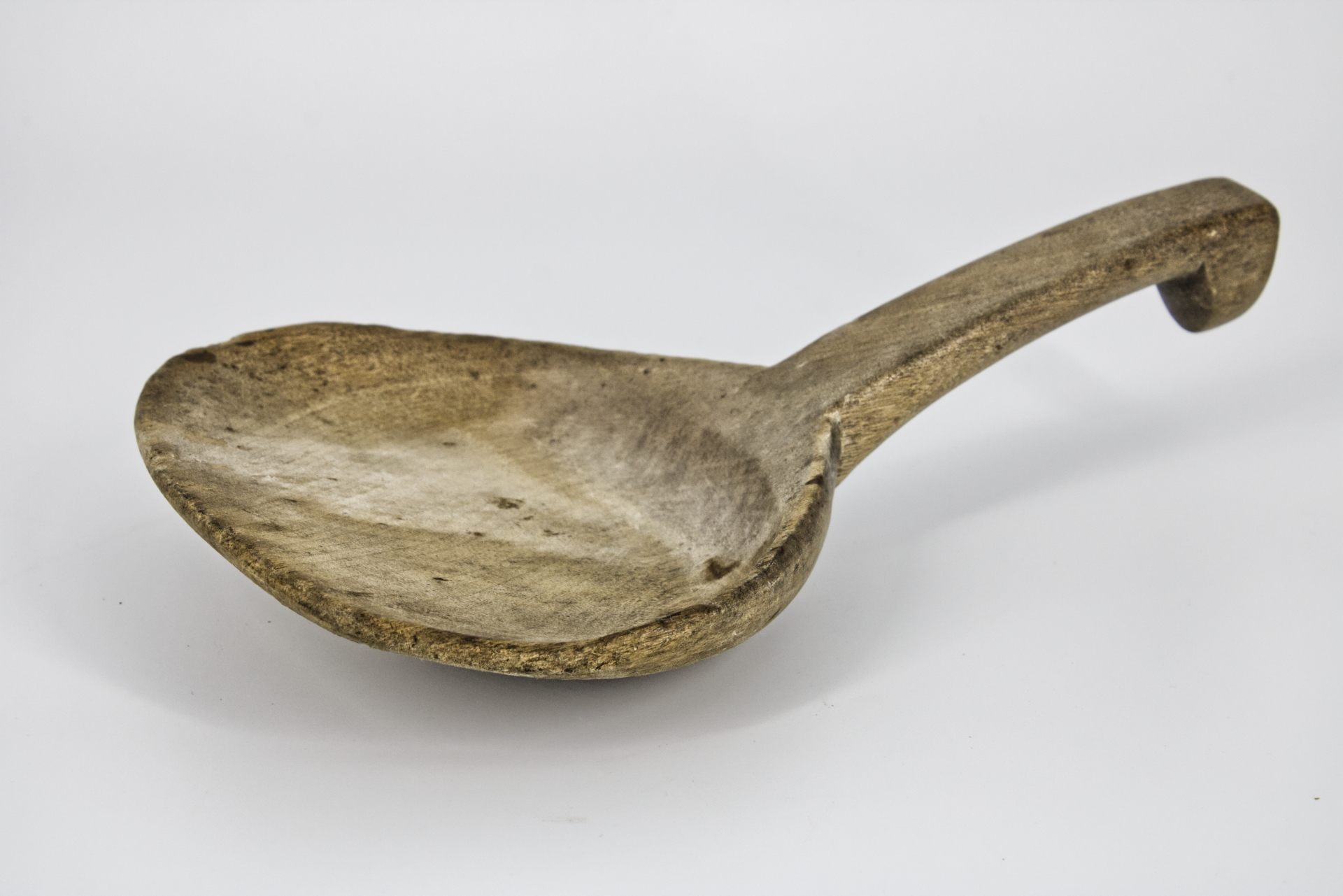
Micouenne, also known as a ladle or rabiole head. A rounded wooden spoon with a hook, carved from a single piece of wood.
Value of the item
The object reflects First Nations expertise in food preparation and maple syrup production. Léandre Bergeron, in his Dictionnaire de la langue québécoise (Quebec Language Dictionary), offers the following definition: "micouenne – n.f. large wooden spoon used to pour maple sugar into molds. Ladle." " Bélisle, in his Dictionnaire nord-américain de la langue française (North American Dictionary of the French Language), is more precise about the origin of the term. According to him, "micouenne is a word of Iroquoian origin (micouan) meaning spoon. " According to Bélisle, micouenne is "a large wooden or bark spoon used to scoop maple sugar and pour it into molds." He specifies that the term is also used to describe a large soup spoon.
Learn more
For the Mi'gmaq people of the Gaspé Peninsula, harvesting maple sap complemented their hunting, fishing, and gathering activities and was an important commodity for trade. Part of this maple sap harvesting took place on the islands of the Grande Cascapédia, including Île du Cheval. In 1784, Loyalist Azariah Pritchard was granted this island, to the detriment of the Mi'gmaq who had settled at the mouth of the river, at the current location of Gesgapegiag. This marked the beginning of nearly two centuries of claims to the island. In 1896, it was still considered to be endowed with a "magnificent sugar maple forest" (https://publications.gc.ca/collections/collection_2009/indianclaims/RC31-60-1994F.pdf). Fourteen camps were once located there.