
Montérégie
Dès 1757, la région accueille quelques Acadiens de retour d’exil, mais c’est après le traité de 1763 qu’ils arrivent en plus grand nombre. Venant de la Nouvelle-Angleterre à pied en passant par le lac Champlain, un groupe se réfugie près du fort Saint-Jean et, en 1768, fonde la paroisse de L’Acadie (Saint-Jean-sur-Richelieu) sur les bords de la rivière Montréal, rebaptisée elle aussi L’Acadie. La grande fertilité du sol leur permet de prospérer rapidement. Ils sont également à l’origine des paroisses de Saint-Luc, de Napierville, de Saint-Jacques-le-Mineur et de Saint-Blaise.
Des familles pionnières, nous retrouvons encore aujourd’hui des Bergeron, Boudreau, Cyr, Hébert, Leblanc, Poirier et Richard.
À Saint-Denis, une quinzaine de familles s’établissent à partir de 1767 dans le rang nommé Petite-Acadie; en 1770, on en compte déjà 160. À Saint-Antoine, un rang dédié aux Acadiens est nommé l’Acadie. D’autres familles s’établissent à Saint-Ours, à Saint-Charles, à Saint-Marc et à Saint-Roch.
Simon Thibodeau et Louis Robichaud, deux Acadiens déportés à Philadelphie et devenus maîtres potiers, développent à Saint-Denis, à partir de 1776, une industrie céramique importante qui sera prospère durant plus d’un siècle.
De nombreux descendants d’Acadiens participent activement aux luttes des patriotes de 1837 et de 1838, notamment les Blanchard, Boudreau, Bourdages, Cormier, Girouard, Hébert et Migneault.
Please click on a link in the list below to go directly to that section:
Saint-Denis-sur-Richelieu
After the deportation and exile of many Acadians in 1755, several of them found a new home in Saint-Denis-sur-Richelieu. They developed the village's 4th row and shared their expertise with the inhabitants.
Among others, many Acadian potters practice their art on the banks of the Richelieu River, train numerous apprentices from Saint-Denis, and share their great talent with the entire community.
While some were just passing through, many chose to settle in the town of Saint-Denis during the 18th century. Today, their descendants—the Robichauds, Leblancs, Martins, to name but a few—are still very much present. Just like the Acadian flags that still fly in the Dionysian sky!
Text written or compiled by Mylène Bonnier and the Acadian Museum of Quebec.
National House of Patriots
Institution
610 Patriotes Road
Saint-Denis-sur-Richelieu – Montérégie
www.mndp.qc.ca
The main mission of this interpretation center is to showcase the history of the Patriots in Lower Canada (now Quebec) in 1837 and 1838. Nearly two centuries ago, Lower Canada was the scene of a wave of opposition and uprisings against the British Crown. Aware that they were living in a rapidly changing world, several thousand men and women rose up against an unequal monarchical regime. Their wish was to establish "a government of the people, by the people, and for the people."
The National House of Patriots wishes to pay tribute to the architects of this heroic struggle. Based on scenes from inside the inn of patriot Jean-Baptiste Mâsse, the exhibition delves into the heart of these rebellions, in all their complexity.
The House also offers a wide range of cultural activities for the whole family: historical presentations, heritage tours of the inn and village, discovery packages, temporary exhibitions, and educational activities.
Text written or compiled by Mylène Bonnier and the Acadian Museum of Quebec.
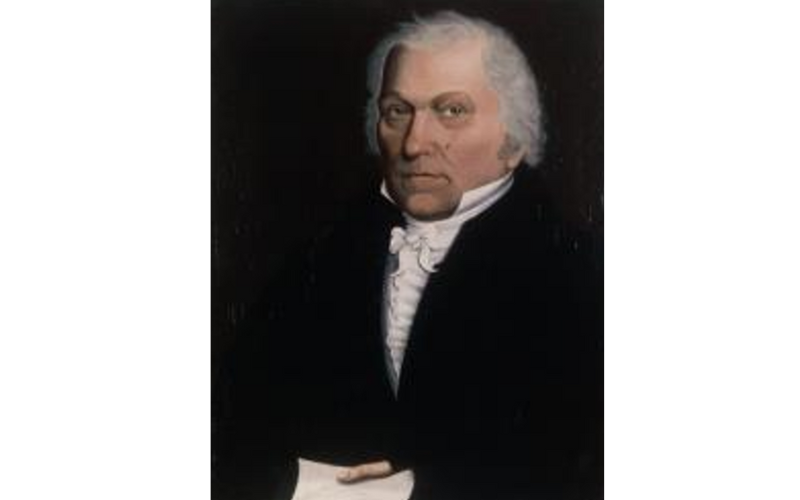
Louis Bourdages (1764–1835)
Personality
Louis Bourdages was born in Loretteville. He was a sailor, farmer, landowner, militia officer, politician, notary, and civil servant.
In 1790, he moved to Saint-Denis and bought land that he cultivated himself. In 1800, he turned to notarial work. As a landowner and country notary, he came to play an important role in his community. He was first appointed agent of the seigneury and became the custodian of several merchants' money.
A member of the Canadian Party, he was elected in Richelieu County for four terms, from 1805 to 1815, then in Buckingham in 1815. A skilled tactician and eloquent and persuasive speaker, Bourdages quickly established himself as a seasoned parliamentarian. In 1820, he was re-elected in Buckingham and represented that division for ten years. He was then elected for five years in the riding of Nicolet, where he rallied to the cause of patriot Louis-Joseph Papineau and his ideas.
As he approached his 70th birthday, Louis Bourdages became increasingly radical in his political views. He accomplished one of the last major acts of his political career by participating in the drafting and dissemination of the 92 Resolutions, a document setting out the Assembly's main grievances and demands. He died in Saint-Denis-sur-Richelieu.
Text written or compiled by the Acadian Museum of Quebec
Heritage tour
Place of interest
This heritage trail highlights four important themes: the history of Saint-Denis, the architecture of its buildings, its religious heart, and its natural and agricultural riches. The trail includes a panel entitled "Where history is cultivated," which mentions the arrival of the Acadians. A second panel explains the presence of the Acadian flag in Saint-Denis.
Text written or compiled by Mylène Bonnier.
Source: Municipality of Saint-Denis-sur-Richelieu
National House of the Patriots: www.mndp.qc.ca
Bourdages Street sign
Place of interest
The names of streets, businesses, and public places, inspired by the events of the Patriotes rebellion, bear witness to the mark left by this chapter of history in the municipality. Bourdages Street was officially named in 1983 in honor of Louis Bourdages, member of Parliament for the region from 1805 to 1835.
Text written or compiled by Jacques Gaudet and the Acadian Museum of Quebec.
Longueuil
Statue of Jean Béliveau
Place of interest
1755 Jacques-Cartier Boulevard East
A statue of Jean Béliveau stands proudly in front of the Coliseum that bears his name. It was unveiled during Longueuil's 350th anniversary celebrations in 2007, in the presence of family members, friends, dignitaries, and a crowd of admirers who came to pay tribute to their idol.
Cast in bronze at the Inverness Bronze Workshop and mounted on a concrete base, this sculpture was created by Jules Lasalle and Annick Bourgeau of the Attitudes workshop. It stands eight feet tall and was inspired by a photo of Béliveau from the 1960s.
Text written or compiled by the Acadian Museum of Quebec.
Saint-Jean-sur-Richelieu, Acadia sector
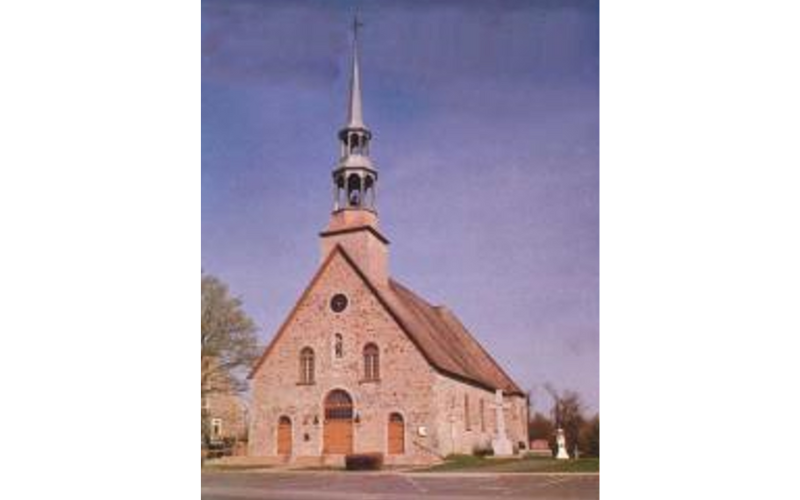
Church of St. Margaret of Blairfindie
Place of interest
1450 Bell Tower Road
The church of Sainte-Marguerite-de-Blairfindie was built in 1800 and 1801. Located off the beaten track, it occupies an unusual location, considering that places of worship usually form the center of Quebec villages.
This building is of heritage interest due to its architectural value. The church illustrates the persistence of French-inspired religious architecture in the early 19th century. The artistic value of the interior decoration is also noteworthy. Part of the decoration and liturgical furnishings were designed by sculptors Georges Finsterer and his son, Louis-Daniel, between 1800 and 1822.
The paintings on the walls of the nave were created by the painter Yves Tessier in 1826 and 1828. The church is part of a remarkably well-preserved Catholic religious complex. This complex includes the presbytery (1821), the covered walkway connecting the church to the presbytery (1822), the parish school (1831), and the cemetery. The cemetery bears witness to the presence of Acadian deportees and Irish immigrants.
The church was designated a heritage building in 1957 by the Quebec Ministry of Culture and Communications. Twenty-two designated heritage objects are also associated with the site.
In 1971, one of the authors chronicling Acadian history in Quebec, Father Pierre-Maurice Hébert, declared that "the beautiful church of L'Acadie was built with the money and sweat of the Acadians; it is their finest monument in Quebec."
Text written or compiled by the Acadian Museum of Quebec.
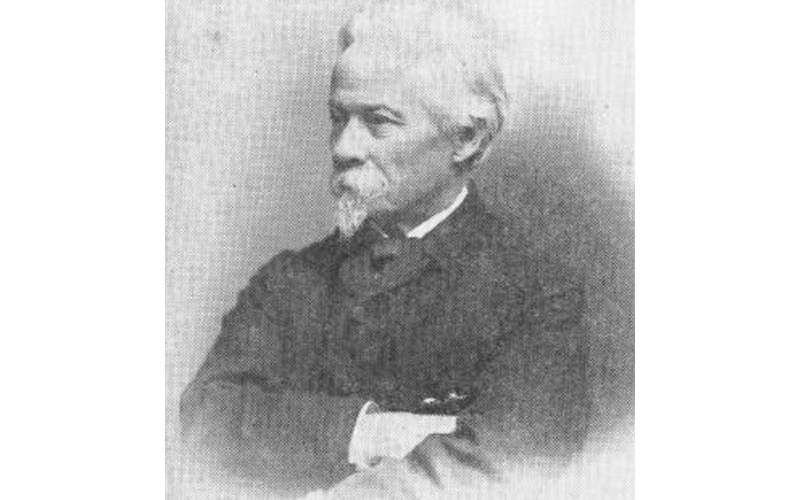
Napoléon Bourassa (1827–1916)
Personality
Napoléon Bourassa, born in Acadia, is a painter, author, teacher, sculptor, and architect. Although he is not of Acadian descent, we felt it appropriate to include him among Acadian personalities due to his contribution to Acadian culture and history.
He studied for eleven years with the Sulpicians at the College of Montreal. In 1848, he did an internship in law, but chose to study painting with Théophile Hamel. From 1852 to 1855, he continued his artistic training in Europe. In 1857, he married Azélie Papineau, the daughter of Louis-Joseph Papineau, and set up his art studio in Montebello, in the Outaouais region.
Early in his career, he worked mainly as an art critic, author, and professor. He wrote a novel about the separation of two young lovers during the deportation of the Acadians. This work, entitled Jacques et Marie, souvenir d'un peuple dispersé (published in 1866), first appeared between July 1865 and August 1866 in the Revue canadienne, a publication he founded.
In 1880, he founded the National Gallery of Canada with fellow artists. In 1883, he was consulted on the construction of the Quebec Legislative Assembly. Bourassa had many famous apprentices, including Louis-Philippe Hébert.
In terms of church architecture and interior decoration, Napoleon Bourassa's works include the decoration of the chapel at the Nazareth asylum (1870), the Notre-Dame-de-Lourdes Chapel in Montreal (1872-1880), the wall decoration of the Saint-Ours Church (undated), the façade of the Dominican convent in Saint-Hyacinthe (1892), and the Sainte-Anne Church in Fall River (1892-1904). He died in Lachenaie at the age of 89.
Text written or compiled by the Acadian Museum of Quebec.
Mother Marie-Léonie Paradis (1840–1912)
Personality
Élodie Paradis (baptized Alodie-Virginie), known as Mother Marie-Léonie, was born in Acadia.
She took her vows in 1857 at the novitiate of the Marianist Sisters of Holy Cross in Saint-Laurent, near Montreal. She then worked as a teacher, supervisor, and secretary to the superior in Varennes. In 1870, she joined the American branch of the Sisters in Indiana. In 1874, Sister Marie-Léonie led a group of novices and postulants at Saint Joseph's College in Memramcook, New Brunswick.
In 1880, she founded the Institute of the Little Sisters of the Holy Family. She helped save the Acadian nationality, which was threatened and doomed to Anglicization. Appointed superior of the new community, she repeatedly attempted to obtain approval for her religious family from the Bishopric of Saint John, but to no avail. In 1895, the bishop of Sherbrooke agreed to host the mother house and novitiate of the Little Sisters. The founder and her work moved there in 1895. In 1896, the bishop granted canonical approval, which enshrined the Church's recognition of the Institute.
At the time of its founder's death, the Institute had some 635 members. Mother Marie-Léonie was beatified in Montreal on September 11, 1984, during Pope John Paul II's visit to Canada. The Church thus recognized a pioneering woman. She died in Sherbrooke.
Mother Marie-Léonie receives the title of historical figure.
On December 19, 2016, Luc Fortin, Member of Parliament for Sherbrooke, Minister of Culture and Minister responsible for the Protection and Promotion of the French Language, and Minister responsible for the Estrie region, designated Élodie Paradis, known as Mother Marie-Léonie, as a historical figure. This symbolic gesture was made under the Cultural Heritage Act in order to preserve her memory for generations to come.
The designation of Mother Marie-Léonie brings us back to the historic role of religious communities in the evolution of Quebec society in terms of health, education, and social services. I am proud to take this significant step in honor of this great figure who was closely linked to the life of the Sherbrooke community. Her work will remain engraved in our collective memory," said Minister Fortin.
Called early, Mother Marie-Léonie devoted her life to prayer and helping others. Like her community, she upheld important Christian values: unity, charity, welcoming others, and humility. She remains an eloquent model in terms of her spiritual journey and the fulfillment of the noble mission to which she was devoted," said Bishop Luc Cyr.
Sister Marie-Léonie remains an inexhaustible source of inspiration for all of us. I would humbly add that the designation of our founding mother also highlights our community's deep commitment to colleges, scholastics, and students, added Sister Marie Paule Carrier, secretary general of the community of the Little Sisters of the Holy Family.
Text taken from the press release issued by the Quebec Ministry of Culture and Communications.
Text written or compiled by the Acadian Museum of Quebec.
Monument to the Ancestors
Place of interest
Ancestors Park, Bell Tower Road
This monument pays tribute to ancestors. It was erected during the bicentennial celebrations of the parish of L'Acadie in 1982.
1782-1982
To our valiant Acadian and Canadian ancestors
Tribute and glory
Erected on the occasion of the 200th anniversary
By the festival committee
June 1982
Text written or compiled by the Acadian Museum of Quebec.
Monument to the Patriots
Place of interest
739 Patriots Road
Erected in 1983 by the Société des Patriotes du Québec, the monument commemorates the rebellions of 1837–1838. Nicolas Grégoire’s brother Narcisse, who was killed during the inglorious episode at Bullis Farm near the US border at Rouses Point (and not at the Battle of Lacolle Mill), was buried on this former land belonging to Nicolas Grégoire. Nicolas was unable to obtain permission from the bishop to exhume him and bury him in the village cemetery on the Grégoire family land. Despite extensive research, it is not known exactly where he might have been buried on the family land. The grave of Narcisse Grégoire near the monument is a fictitious grave to commemorate his memory.
Jérémie Giles' work consists of two steles resting on a shared base. The stele on the left bears the inscription "Passant souviens-toi" (Passersby, remember) and a plaque with the following text:
The nation pays tribute to its valiant sons, the patriots of 1837-1838, who, with makeshift weapons, heroically defended their rights, their freedom, and their independence, and who were driven from their villages, deported, and hanged. The people of Quebec remember the pain of their wives and children who, in addition to their grief, had to endure terrible reprisals against them: houses burned, lands ravaged, humiliations of all kinds. The people here remember. The Society of Patriots of Quebec, November 19, 1983.
The stele on the right bears the inscription"To our valiant patriots"and a plaque depicting a group of patriots armed with rifles and spades marching into battle.
In Quebec, several monuments, statues, plaques, and parks honor the memory of the patriots, not to mention the designation of Chemin des Patriotes in 1977, which crosses the Montérégie region. In this region, there are several monuments inscribed with the names of Acadians: in Saint-Ours, Saint-Denis-sur-Richelieu, and Saint-Charles-sur-Richelieu.
Text written or compiled by the Acadian Museum of Quebec.
Monument to the Acadian Odyssey in Acadia
Place of interest
Parc des Ancêtres in the Acadie sector of Saint-Jean-sur-Richelieu
The monument is part of the international commemoration project for the Great Upheaval, led by the Société Nationale de l’Acadie. The aim of this project is to highlight the odyssey of the Acadian people. In 2018, sixteen monuments have already been erected, including five in New Brunswick, three in Nova Scotia, one in Prince Edward Island, one in Newfoundland and Labrador, four in Quebec, one in Louisiana, and one in Miquelon (France).
The City of Saint-Jean-sur-Richelieu, in collaboration with the Société acadienne Port-Royal and the Commission de l’Odyssée acadienne, unveiled the Acadian Odyssey monument on September 11, 2016. The ceremony took place in Parc des Ancêtres in the Acadie sector of Saint-Jean-sur-Richelieu. Several dignitaries and guests attended the event.
The monument was unveiled in memory of the ancestors and founders of "L'Acadie," a town founded by Acadian emigrants fleeing deportation. This project commemorating the Great Upheaval aims to highlight, in a tangible and permanent way, the odyssey of the Acadian people in Canada, North America, and elsewhere in the world. It aims to commemorate the Great Upheaval, raise awareness of Acadian history and culture, and promote contemporary Acadia.
Text written or compiled by the Acadian Museum of Quebec.
Monument to Marie-Léonie Paradis
Place of interest
Next door to 879 Patriotes Road
A cairn was erected in 1968 marking the birthplace of Élodie-Virginie Paradis.
Sherbrooke is also home to the Marie-Léonie Paradis Center, which houses a museum in her honor. Run by the Little Sisters of the Holy Family, its mission is to promote awareness of the life and work of the founder of this congregation.
Napoléon Bourassa Monument
Place of interest
Erected on the bicentennial of Acadia, this monument pays tribute to a native son of the parish, Napoléon Bourassa, known as the "apostle of art" in French Canada. The bronze sculpture is the work of Jérémie Giles.
Text written or compiled by the Acadian Museum of Quebec.
Heritage festivals
Event
Since 2002, the Acadian Heritage Festival has celebrated Acadian pride every year with a colorful program of activities and performances. It is a true celebration of history in the first parish of Haut-Richelieu.
Mural in memory of the people of Acadia
Place of interest
535 Old Mills Road
The history of Acadia is now inscribed on the north wall of the Napoléon-Bourassa school. Artist Hélène Ferdais created various symbols and figures that shaped the village's history, which are incorporated into the Acadian flag.
It took a total of 292 hours of work to complete the mural dedicated to the memory of the people of the small colony of L'Acadie, now part of Saint-Jean-sur-Richelieu. Work began in mid-July 2016 and continued until the end of August. The mural is 71 feet long and 20 feet high.
The Flag
Hélène Ferdais worked with historian Marilou Desnoyers to select the key figures and events for the Acadian timeline. It was then that the idea of the flag in the background came to the artist. “Each section of the flag has its own meaning,” she says. The blue, which represents faith in the future of the people, is symbolized by the deportation to the Montérégie region. The white evokes the building of the community despite hardships, and the red is associated with the symbolism of martyrdom and war. "However, we changed the meaning of this section slightly since the work is painted on the wall of an elementary school. We wanted to avoid scenes of war. Here, the red evokes the present and future of the community." This chapter is represented by various figures from today, including the bow of violinist Christian Poupart. A space is reserved for students, who will redesign a new work each year on a removable panel. The star of the flag is also incorporated into the work. Inside are inscribed the motto Santa Maria Stella and the coat of arms of Acadia.
"There are so many symbolic elements and characters that it's good to stop and take the time to discover the subtleties of the work," concludes Hélène Ferdais. "In fact, the mural was designed with many small details that compel passersby to stop and look at it."
Text written or compiled by Isabelle Laramée.
Saint-Cyprien-de-Napierville
Louis Cyr Monument
Place of interest
105 Louis-Cyr Road
The monument is located very close to where Louis Cyr was born. In June 2013, the municipality celebrated the 150th anniversary of Cyr's birth in the presence of elected officials from the region and the mayor of Saint-Jean-de-Matha. On this occasion, a monument was unveiled consisting of a huge 15-ton stone with a black granite plaque depicting the face of Louis Cyr. The high school, a park, and a road also bear his name.
Text written or compiled by the Acadian Museum of Quebec.
Contact us
95 Port-Royal Avenue, Bonaventure, G0C 1E0
[email protected]
418-534-4000 | Toll-free: 1-833-920-3900
SCHEDULE
mardi au vendredi : 9 h à 12 h et 13 h à 16 h
dimanche : 13 h à 16 h

NEWSLETTER
Sign up to our newsletter now.
ABOUT US
Our purpose
Team
Career
Our partners
INFORMATION
News
Annual reports
Learn about Acadia
General policies
GROUP VISIT
School trip
Tour operator
CORPORATE
Room rental
Call for projects