
Mauricie
Après la prise de Québec par les Anglais en 1759, plusieurs Acadiens prennent la route et s’installent dans la région de Trois-Rivières où les conditions de vie sont meilleures.
Vers 1760, à Pointe-du-Lac, 11 familles s’établissent dans la seigneurie de Tonnancour. Après le traité de 1763, d’autres arrivent des colonies américaines.
En 1767, à Yamachiche, une quarantaine de familles arrivent d’un exil de 12 ans au Massachusetts et s’installent dans des concessions de la seigneurie de Gros-Bois qu’ils nomment Grande-Acadie et Petite-Acadie. Une artère importante reliant Yamachiche à trois autres municipalités se nomme aujourd’hui le chemin des Acadiens; elle témoigne de l’arrivée massive des Acadiens à cet endroit.
D’autres s’établissent dans des paroisses existantes comme La Pérade, Batiscan, Champlain, Cap-de-la-Madeleine, Louiseville et Maskinongé. Au fil des ans, certaines familles s’implantent dans les environs, comme celle des ancêtres du conteur Fred Pellerin de Saint-Élie-de-Caxton.
Des familles pionnières encore présentent aujourd’hui, nous retrouvons, entre autres, des Aucoin, Bastarache, Comeau, Doucet, Garceau, Landry, Lebrun, Leblanc, Lord, Melançon, Pellerin, Trahan et Thibodeau.
Please click on a name in the list below to go directly to its designated section.
Muskellunge
Le Brun General Store
Place of interest
192 route Pied-de-la-Côte
The Le Brun general store site consists of three buildings that served as general stores between 1827 and 1974. This business prospered for nearly a century and a half.
Acadians Charles and Victoria Le Brun purchased the business in 1901. They left it to their son Odilon, who went into partnership with his brothers, Oscar and Joseph. Le Brun et frères remained in business until 1974. The property subsequently changed hands several times, but in the interest of authenticity, the store was left as is, with its original counters, floors, and chandeliers. Antiques were added to turn it into a museum from 1998 to 2007. Finally, in 2009, the current owners purchased the buildings and the collection of objects to continue its use as a museum. Opened to the public in 2010, this general store, typical of the 19th and 20th centuries, is a place where you can smell, see, hear, touch, and taste. It tells the story of Odilon Le Brun, merchant.
Le Brun general store was designated a heritage site in 2012 by the Quebec Ministry of Culture and Communications.
Text written or compiled by the Acadian Museum of Quebec.
Doucet House
Place of interest
184, route du Pied-de-la-Côte
The Doucet house was built between 1765 and 1794. It is an example of late 18th-century rural architecture.
The Doucet House is also of historical interest. The residence bears witness to events linked to the history of the Acadians. Charles Doucet, its builder, was exiled during the deportation (1755-1763). He left all his possessions in Port-Royal to settle in Sorel with his family. A few years later, when Governor James Murray allowed the Acadians to settle in Canada, he bought land in Maskinongé, like many families of Acadian origin who came to settle in the Maskinongé and Yamachiche region.
Doucet built his house on land he purchased from Jean-Baptiste Drolet, along Chemin du Roy. This house, along with the former presbytery of Saint-Joseph-de-Maskinongé and Le Brun stores, evokes the history of the original settlement along Lake Saint-Pierre. It is considered one of the oldest buildings in the region.
The first five generations of the Doucet family to live in the house made it a rule to pass the residence on to the eldest son. For more than two centuries, the house was inhabited by this family.
The Doucet House was designated a heritage building in 1978 by the Quebec Ministry of Culture and Communications.
Text written or compiled by Diane Robert and the Acadian Museum of Quebec.
Yamachiche
Acadian connection to the town of Yamachiche
In 1767, a large group of Acadians from Massachusetts arrived by schooner on the Grande Rivière Yamachiche. Forty-two Acadian families settled in Yamachiche, including the Landrys, the Mélançons, and the Thibodeaus. Over the years, some of them moved to surrounding parishes, such as the ancestors of storyteller Fred Pellerin of St-Élie-de-Caxton.
Acadians feature prominently in the history of the municipality. There are several indications of this:
- The "Pavillon Achille-Trahan" reception area;
- The monument of the Acadian Garceau family;
- An important road connecting Yamachiche to three (3) municipalities, namely St-Barnabé-Nord, St-Sévère, and St-Léon-le-Grand, is called "Chemin des Acadiens" (Acadian Road). This road bears witness to the mass arrival of Acadians in Yamachiche. In this area, we find Acadian families such as the Trahans, Pellerins, etc.
The municipality's website pays tribute to the Acadians of Yamachiche, who are very active in all areas of life in the Mauricie region.
The book Yamachiche et son histoire 1672-1978 (Yamachiche and its history 1672-1978) provides an excellent account of the experiences and surnames of the Acadians of Yamachiche.
Text written or compiled by André Desaulniers
Source: Yamachiche et son histoire 1672-1978 (Yamachiche and its history 1672-1978), J.-Alide Pellerin, historian, published by Le Bien Public, 1980 Yamachiche, terre d’accueil des Acadiens (Yamachiche, home of the Acadians), André Desaulniers, August 2, 2010. History section on the municipality's website.
Monument to the Garceau and Doucet families
Place of interest
Saint Anne Street, next to the church
Wishing to thank their adopted homeland, the Garceau family unveiled a monument in July 1995 during a large family gathering. This family was among the first Acadians to settle in Yamachiche.
After being driven
from our lands in Acadia in 1755
and held captive in a foreign country
under harsh conditions.
We are now free
and have chosen this land
as our new homeland.
Our descendants will put down roots here
and remember their origins.
Daniel Garceau and Anne Doucet
Unveiling 1995-07-08
Text written or compiled by Diane Robert and the Acadian Museum of Quebec
Achille-Trahan Park and Pavilion
Place of interest
Saint Anne Street, between the church and the school.
The park and the Achille-Trahan pavilion were inaugurated on June 17, 2006. They were built in memory of Achille Trahan, one of the great builders of Yamachiche. This event coincided with the 50th anniversary of the creation of his logging company, ATRAHAN Transformation Inc.
During the ceremony, Achille Trahan's origins are highlighted several times. The Trahans are among the 42 families who were deported from their homeland and settled in Yamachicho concessions in the 18th century.
The Trahan family wants to highlight the important role Acadians have played in the municipality and surrounding parishes by building this pavilion. Two interpretive panels at the park entrance highlight the Acadian presence in Yamachiche and the place of Achille Trahan and his business in the community.
The park also includes a playground for children, bocce and shuffleboard courts, benches, and picnic tables.
Text written or compiled by Diane Robert and the Acadian Museum of Quebec
Three Rivers
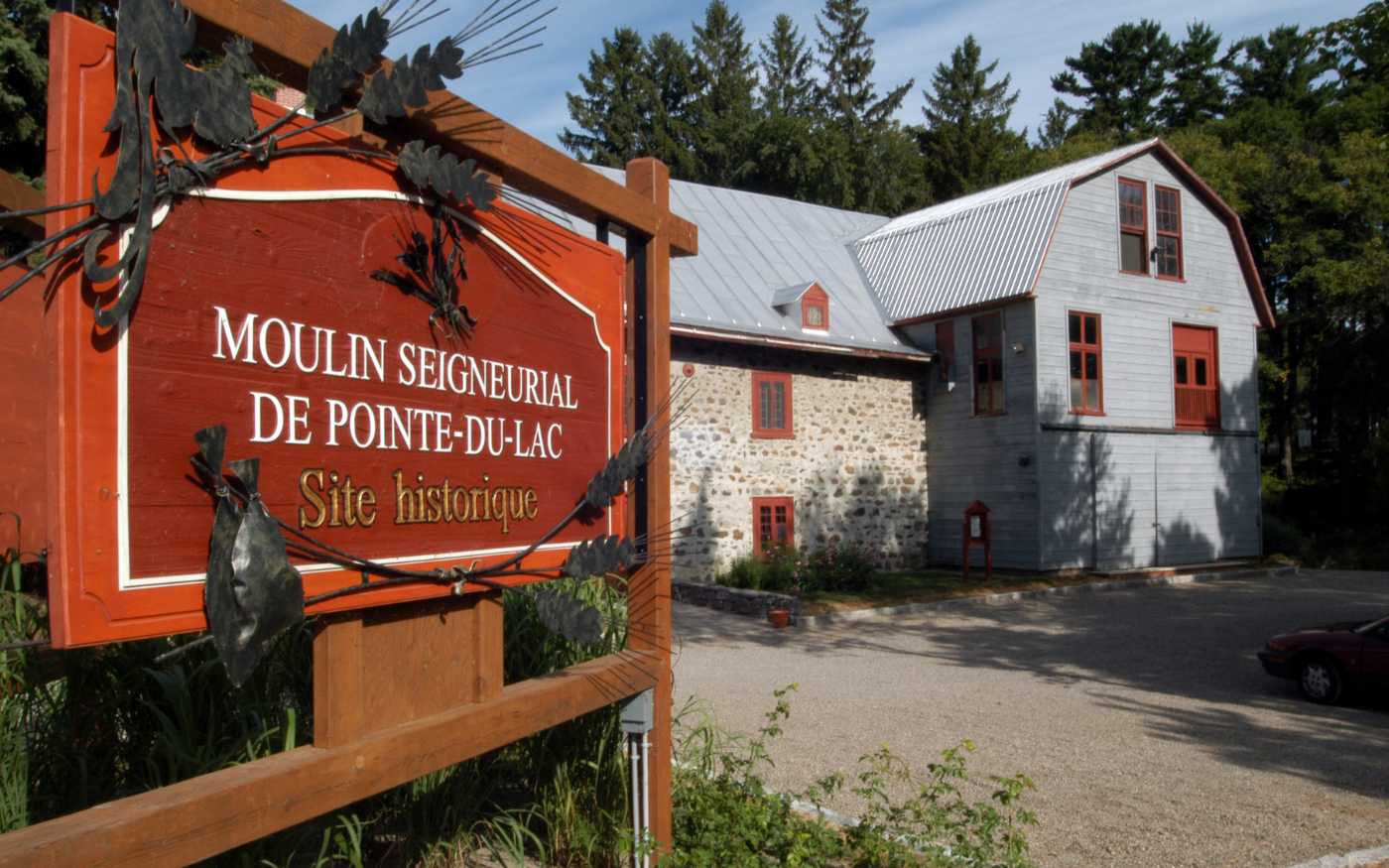
Pointe-du-Lac seigneurial mill
Place of interest
11,930 Notre-Dame Street West
The Pointe-du-Lac Seigniorial Mill is an interpretation center consisting of two buildings: a flour mill dating back to the seigniorial era and a sawmill built in the mid-20th century. The Maître meunier exhibition reveals the daily life of millers of yesteryear and the secrets of flour production, while the Farine de bois 2.0 exhibition focuses on the interpretation of the sawmill.
The flour mill was built between 1765 and 1784 by the seigneur of Tonnancour. Following the abolition of the seigneurial system in 1854, farmers were no longer bound by the obligation to grind their grain there and pay royalties, thus ending the monopoly that had been in place for over 130 years. The flour mill then became the property of Acadian millers Pierre-Olivier Duplessis, from 1873 to 1900, and Thomas Garceau, until 1927.
Finally, in 1927, the Brothers of Christian Instruction community acquired the mill. In the late 1940s, the community built a small sawmill adjacent to the main building. Milling operations ceased in 1962–1963. In 1973, the Corporation du Moulin seigneurial de Pointe-du-Lac was founded. This organization aims to renovate the mill and promote tourism activities. Over the following years, the site underwent major restoration work.
The mill was designated a heritage building in 1975, and the entire Moulin-Seigneurial-de-Tonnancour heritage site was designated in 2006 by the Quebec Ministry of Culture and Communications.
Text written or compiled by the Acadian Museum of Quebec.
© ARCHIVES OF THE CITY OF TROIS-RIVIÈRES
Jean Béliveau (1931–2014)
Personality
A famous hockey player for the Montreal Canadiens, Jean Béliveau was born in Trois-Rivières. He began his junior career in Victoriaville and turned semi-professional with the Quebec Aces in 1951–1952.
He joined the Montreal Canadiens two years later. He spent nearly 20 years with the team, half of that time as captain, and won 10 Stanley Cups. He won the Art Ross Trophy (team scoring leader), the Hart Trophy (most valuable player), and the Conn Smythe Trophy (most valuable player in the playoffs).
In 1968, he became the second player in the National Hockey League to surpass the 1,000-point career mark. In 1971, when he hung up his skates, Béliveau was his team's leader in almost every offensive category. His number 4 jersey was retired by the team that same year. He was inducted into the Hockey Hall of Fame in 1972.
From 1971 to 1993, he held various positions within the Canadiens organization. Béliveau was named a Companion of the Order of Canada in 1998, the country's highest honor. In 2002, he announced his permanent retirement from all professional activities.
Mr. Béliveau passed away from pneumonia at his home in Longueuil on December 2, 2014.
To pay tribute to Jean Béliveau, a statue of him was installed in front of the Colisée, which bears his name, in the city of Longueuil, and another on the Place du Centenaire des Canadiens de Montréal at the Bell Centre. In addition, on September 16, 2017, Quebec City inaugurated Place Jean-Béliveau in front of the Videotron Center, and the following year, on November 21, 2018, a third statue was unveiled in his honor. EntitledBrisée la glace (Breaking the Ice),it depicts the famous Canadiens player in action.
Text written or compiled by the Acadian Museum of Quebec.
Contact us
95 Port-Royal Avenue, Bonaventure, G0C 1E0
[email protected]
418-534-4000 | Toll-free: 1-833-920-3900
SCHEDULE
mardi au vendredi : 9 h à 12 h et 13 h à 16 h
dimanche : 13 h à 16 h

NEWSLETTER
Sign up to our newsletter now.
ABOUT US
Our purpose
Team
Career
Our partners
INFORMATION
News
Annual reports
Learn about Acadia
General policies
GROUP VISIT
School trip
Tour operator
CORPORATE
Room rental
Call for projects