
Download image
Patterned wine jar | Pu’tai moqopa’q
Information about the object
Historical period
Unknown
Dimensions
Height: 30.50 cm. Outside diameter: 18.50 cm.
Classification
Tools and equipment -- Food production
Accession number
1980.1.170
Division
Material culture -- Tools and equipment for processing raw materials -- Food processing
Collection
Juliette Gauthier Barette
Donor
Juliette Gauthier Barette
Category/theme
Description of the object
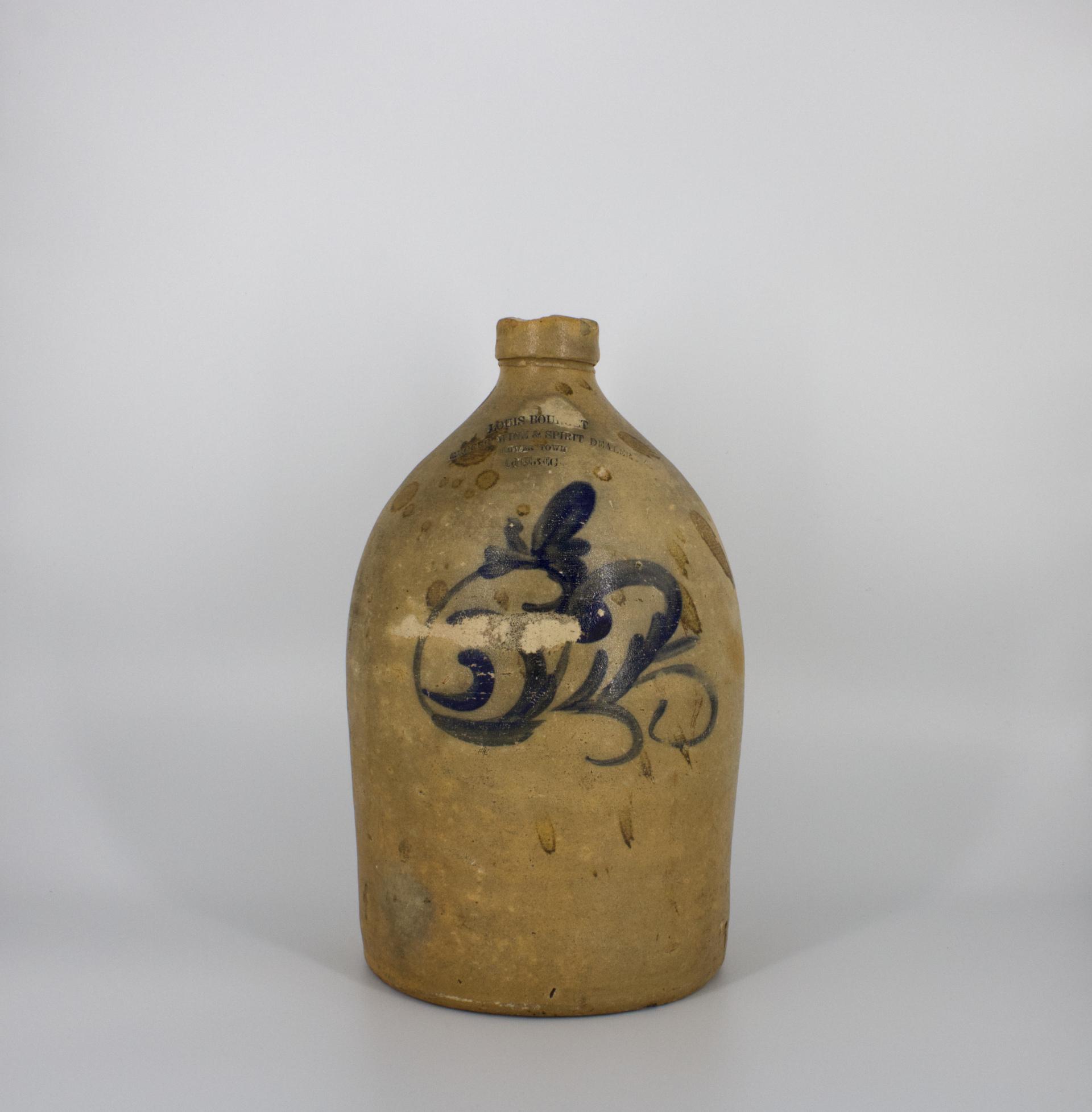
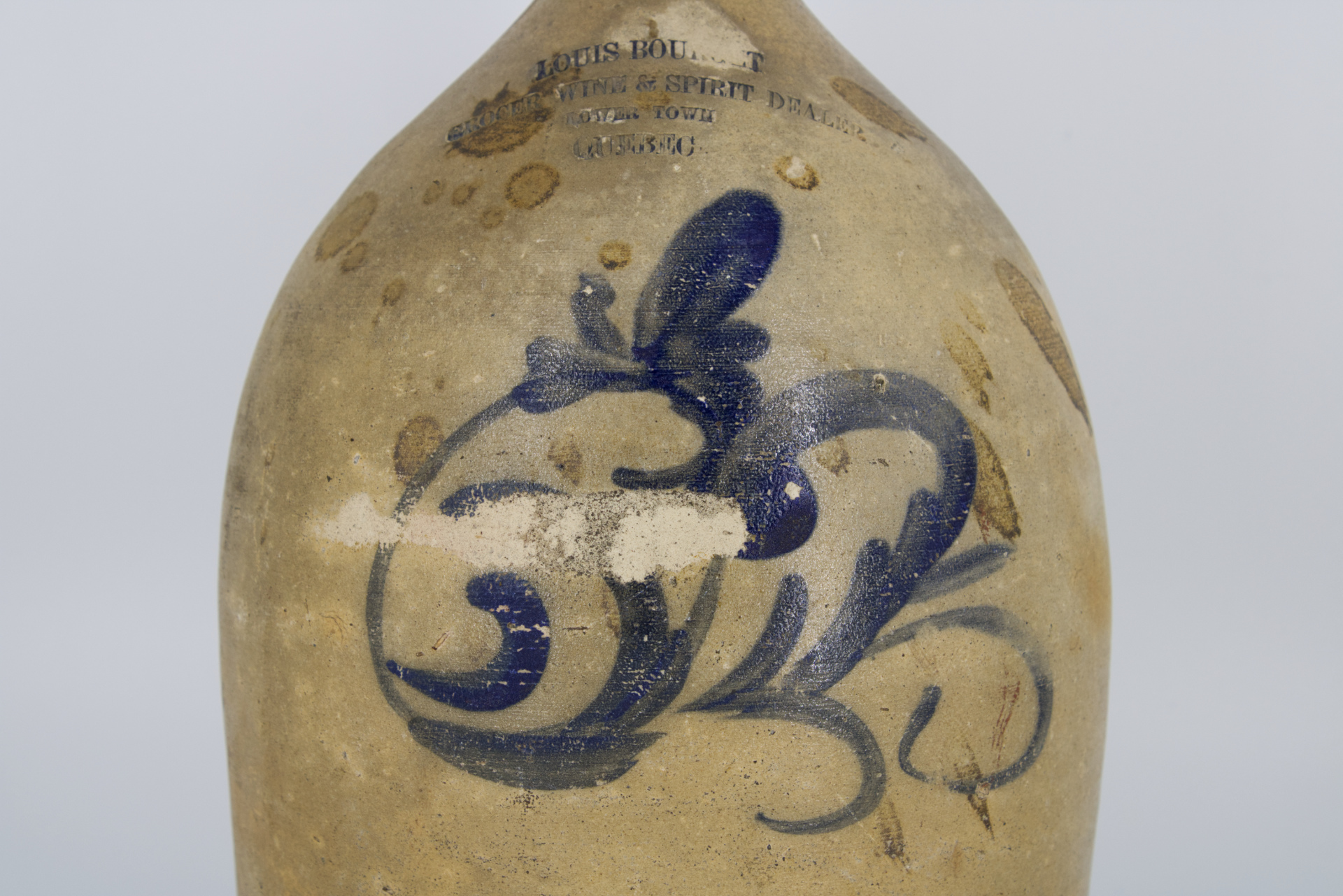
Jug (or pitcher) made of pale brown turned stoneware.
Value of the item
The object bears witness to the development of Acadian and Gaspé society in general. More specifically, the object bears witness to the commercial ties between the Petites-Cadies and the world in the pre-industrial era. The object comes from Quebec City, but was part of Juliette Gauthier Barette's collection of Bonaventure artifacts.
Learn more
Louis Bourget was a spirits and liqueurs merchant as well as a grocer. In 1864, he had two stores: one at the Champlain Market and one near the Finlay Market and Union Street. (https://numerique.banq.qc.ca/patrimoine/details/52327/2029781). Finlay Market has a long history; it is located at what is now Place de Paris in Quebec City. (https://archeologie.ville.quebec.qc.ca/sites/marche-finlay/histoire-du-marche-finlay/). He still owned this last store in 1869, as well as another store in Lévis.
From the 17th to the 19th century, stoneware and pottery were generally imported from Scotland or England. Canadian stoneware really came into its own in the mid-19th century, when the Farrar family, originally from New England, settled in Saint-Jean-sur-Richelieu and began producing salted stoneware. Other pottery manufacturers, such as Burns & Campbell, Eberhard & Halm, and W. E. Welding, set up shop in Ontario. At the end of the 19th century, glass replaced stoneware as the material of choice for food storage.
The cobalt pattern can be found on several jars, including the following: https://www.etsy.com/ca/listing/1354499843/antique-2-gallon-stoneware-merchant?ga_order=most_relevant&ga_search_type=all&ga_view_type=gallery&ga_search_query=stoneware+crocks&ref=sr_gallery-2-36&frs=1&sts=1&organic_search_click=1. In Alsace, this pattern is well known and is achieved using salt. A salt glaze was applied to the pottery before firing at 1230 degrees to achieve a cobalt blue pattern. A famous Alsatian brand that produced this type of pottery was Betschdorf.
From the 17th to the 19th century, stoneware and pottery were generally imported from Scotland or England. Canadian stoneware really came into its own in the mid-19th century, when the Farrar family, originally from New England, settled in Saint-Jean-sur-Richelieu and began producing salted stoneware. Other pottery manufacturers, such as Burns & Campbell, Eberhard & Halm, and W. E. Welding, set up shop in Ontario. At the end of the 19th century, glass replaced stoneware as the material of choice for food storage.
The cobalt pattern can be found on several jars, including the following: https://www.etsy.com/ca/listing/1354499843/antique-2-gallon-stoneware-merchant?ga_order=most_relevant&ga_search_type=all&ga_view_type=gallery&ga_search_query=stoneware+crocks&ref=sr_gallery-2-36&frs=1&sts=1&organic_search_click=1. In Alsace, this pattern is well known and is achieved using salt. A salt glaze was applied to the pottery before firing at 1230 degrees to achieve a cobalt blue pattern. A famous Alsatian brand that produced this type of pottery was Betschdorf.