
Download image
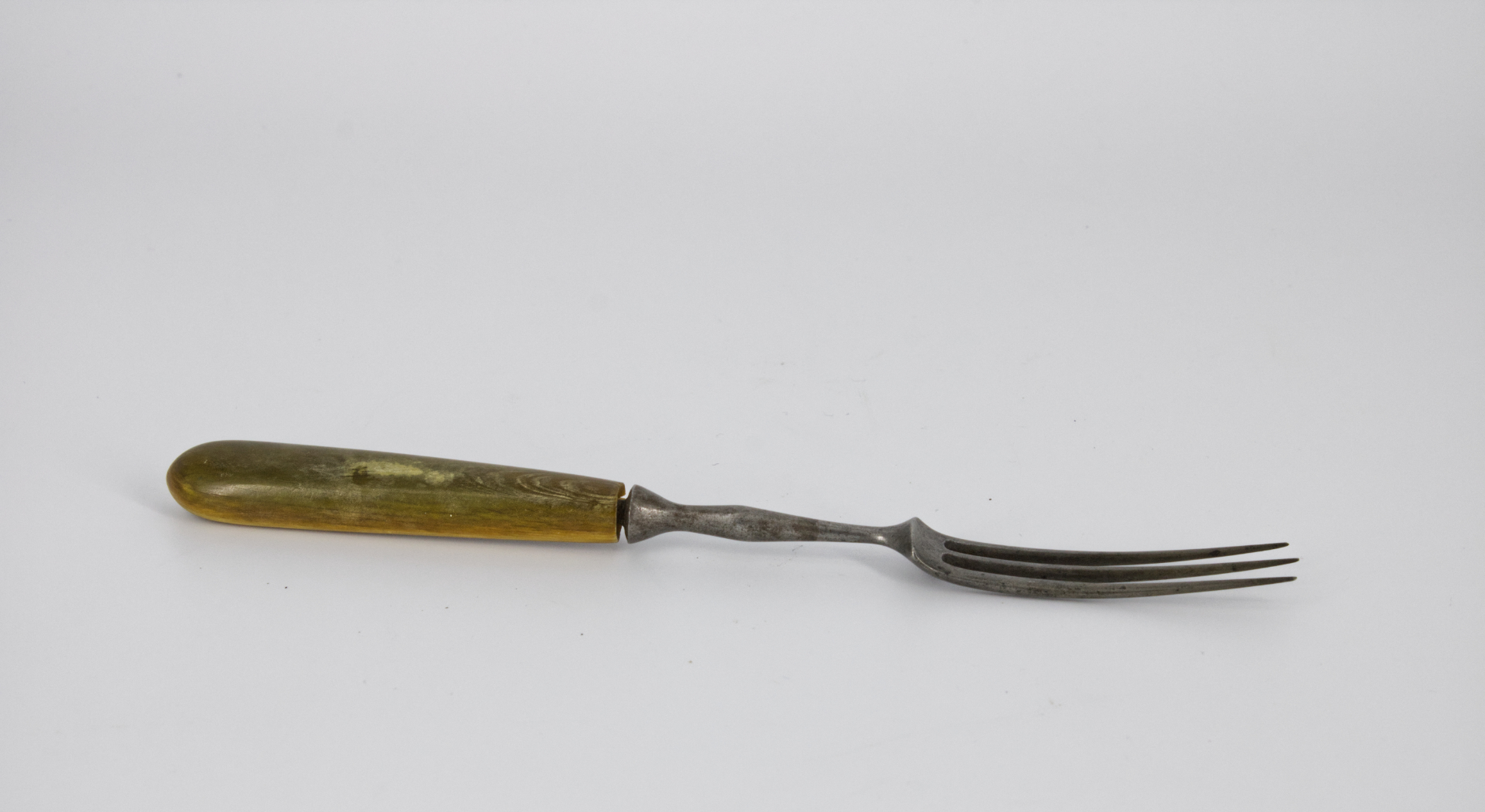
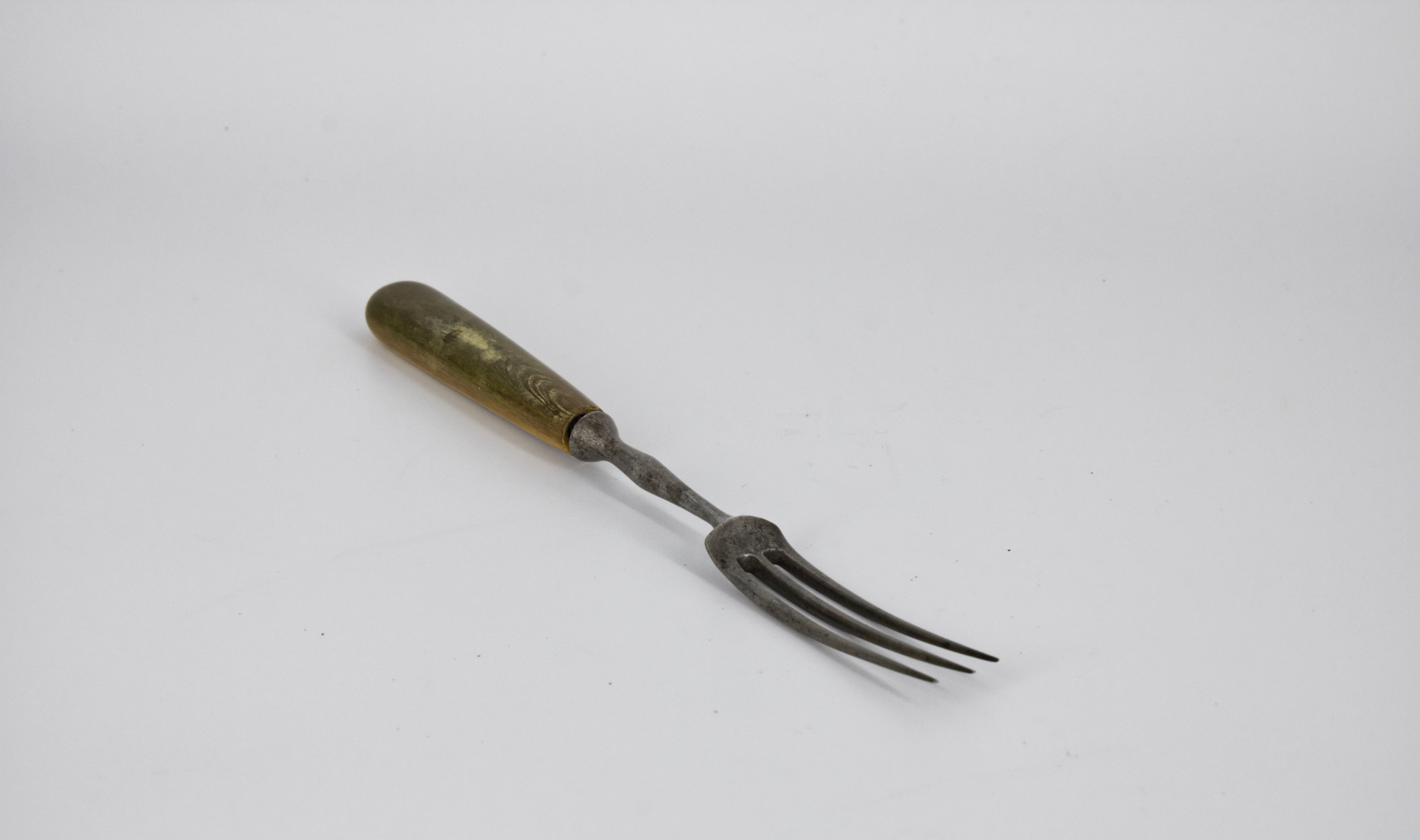
Three-pronged fork | Migwije’maqan
Information about the object
Historical period
c. 1750–1800
Dimensions
Height: 23 cm. Width: 1.6 cm.
Classification
Furnishings and decoration -- Food service
Accession number
2019.0.7
Division
Material culture -- Tools and equipment for processing raw materials -- Food service
Collection
Sylvain Gaudet
Donor
Sylvain Gaudet
Category/theme
Description of the object
This is a three-pronged metal fork with a wooden handle dating from the 18th century. It is believed to be handcrafted.
Value of the item
The object bears witness to the development of Acadian and Gaspé society in general, and more specifically, to the links between the Petites-Cadies of Quebec and other Acadian settlements in the Maritime provinces and the United States. The object comes from a Petite-Cadie: that of L'Assomption.
In addition, the object bears witness to an Acadian family (or families), including that of Joseph Bourg. (https://www.nosorigines.qc.ca/GenealogieQuebec.aspx?genealogie=Bourque_Joseph&pid=630051) Bourg was first married to Marie Blanchard. He was deported to Massachusetts during the Acadian deportation and is believed to have lived in Boston. After this episode, Bourg settled in the village of L'Assomption and married Marguerite Amirault. The fork was kept among his personal belongings.
Finally, the object potentially bears witness to a skill traditionally associated with or practiced by the Acadian population, specifically culinary arts. Indeed, this fork may have been used to serve pieces of meat.
In addition, the object bears witness to an Acadian family (or families), including that of Joseph Bourg. (https://www.nosorigines.qc.ca/GenealogieQuebec.aspx?genealogie=Bourque_Joseph&pid=630051) Bourg was first married to Marie Blanchard. He was deported to Massachusetts during the Acadian deportation and is believed to have lived in Boston. After this episode, Bourg settled in the village of L'Assomption and married Marguerite Amirault. The fork was kept among his personal belongings.
Finally, the object potentially bears witness to a skill traditionally associated with or practiced by the Acadian population, specifically culinary arts. Indeed, this fork may have been used to serve pieces of meat.
Learn more
The three-pronged fork appeared on French tables in the 17th century. At the end of the century, it took on a curved shape that reflected changes in table etiquette. (https://repasgastronomiquedesfrancais.org/2022/01/31/fourchette-histoire-usage-art-de-la-table/amp/?fbclid=IwAR116PsOqe9tU02XwO3RaEyY_Pxx1s4Fyjtr-Kyg3xehZFWn7ZF9JIFhOSM)
The Museum of Designs in Plastics confirms that this three-pronged fork dates back to the 18th century: https://www.modip.ac.uk/artefact/wchl-362
But the fork does not contain any plastic!
The Museum of Designs in Plastics confirms that this three-pronged fork dates back to the 18th century: https://www.modip.ac.uk/artefact/wchl-362
But the fork does not contain any plastic!