
Download image

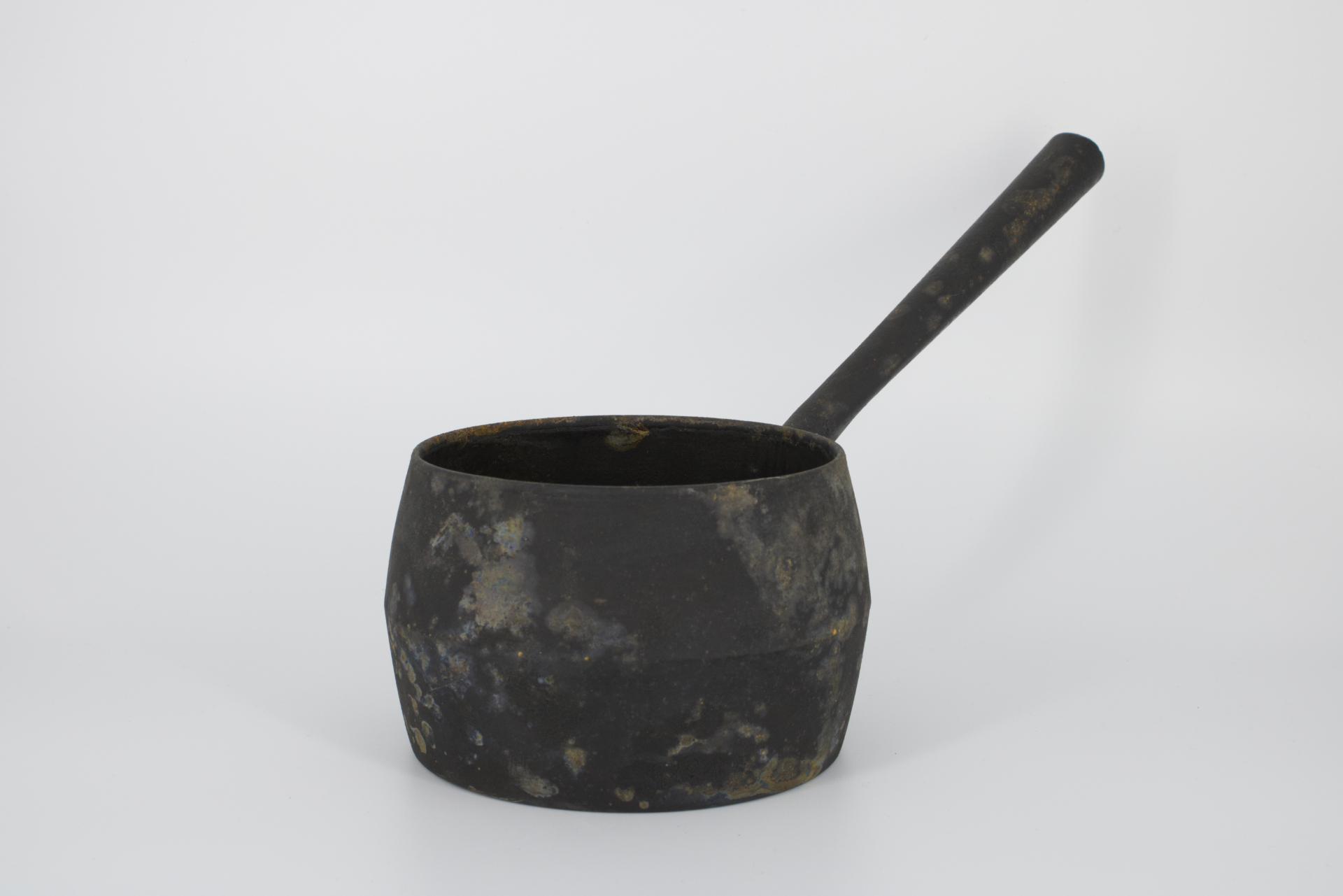
Cast iron cauldron |
Information about the object
Historical period
Unknown
Dimensions
Height: 10 cm. Width: 66 cm. Outside diameter: 14 cm.
Classification
Tools and equipment -- Food production
Accession number
1987.1.374
Division
Material culture -- Tools and equipment for processing raw materials -- Food processing
Collection
Evelyne Allard Landry
Donor
Evelyne Allard Landry
Category/theme
Description of the object
The cauldron has a long handle that could possibly protect it from the embers of the fire, and thus be associated with the life of lumberjack camps. It is covered with matte black paint.
Value of the item
The object reflects a skill traditionally associated with or practiced by the Acadian population, and more specifically, refers to the development of Acadian and Gaspé culinary arts.
Furthermore, if it is true that this object was used in logging camps, then it bears witness to the development of Acadian and Gaspé society in general and, in this case, to life in logging camps, when large mills stood at the mouths of Gaspé rivers. Many Acadians worked in the forestry industry and lived in temporary camps where cooks were responsible for feeding the workers.
Furthermore, if it is true that this object was used in logging camps, then it bears witness to the development of Acadian and Gaspé society in general and, in this case, to life in logging camps, when large mills stood at the mouths of Gaspé rivers. Many Acadians worked in the forestry industry and lived in temporary camps where cooks were responsible for feeding the workers.
Learn more
Many logging camps were established in the 20th century in the Gaspé hinterland and at the mouths of streams and rivers. Like many Gaspesians, Acadians participated in this industry by becoming loggers, log drivers, wood sharpeners, etc. Camps were located near Creux Creek in Saint-Alphonse, near the Bonaventure River, and behind Carleton.
Although this cauldron appears to have been used for preparing sauces, its exact purpose remains unclear.
Although this cauldron appears to have been used for preparing sauces, its exact purpose remains unclear.