
Download image

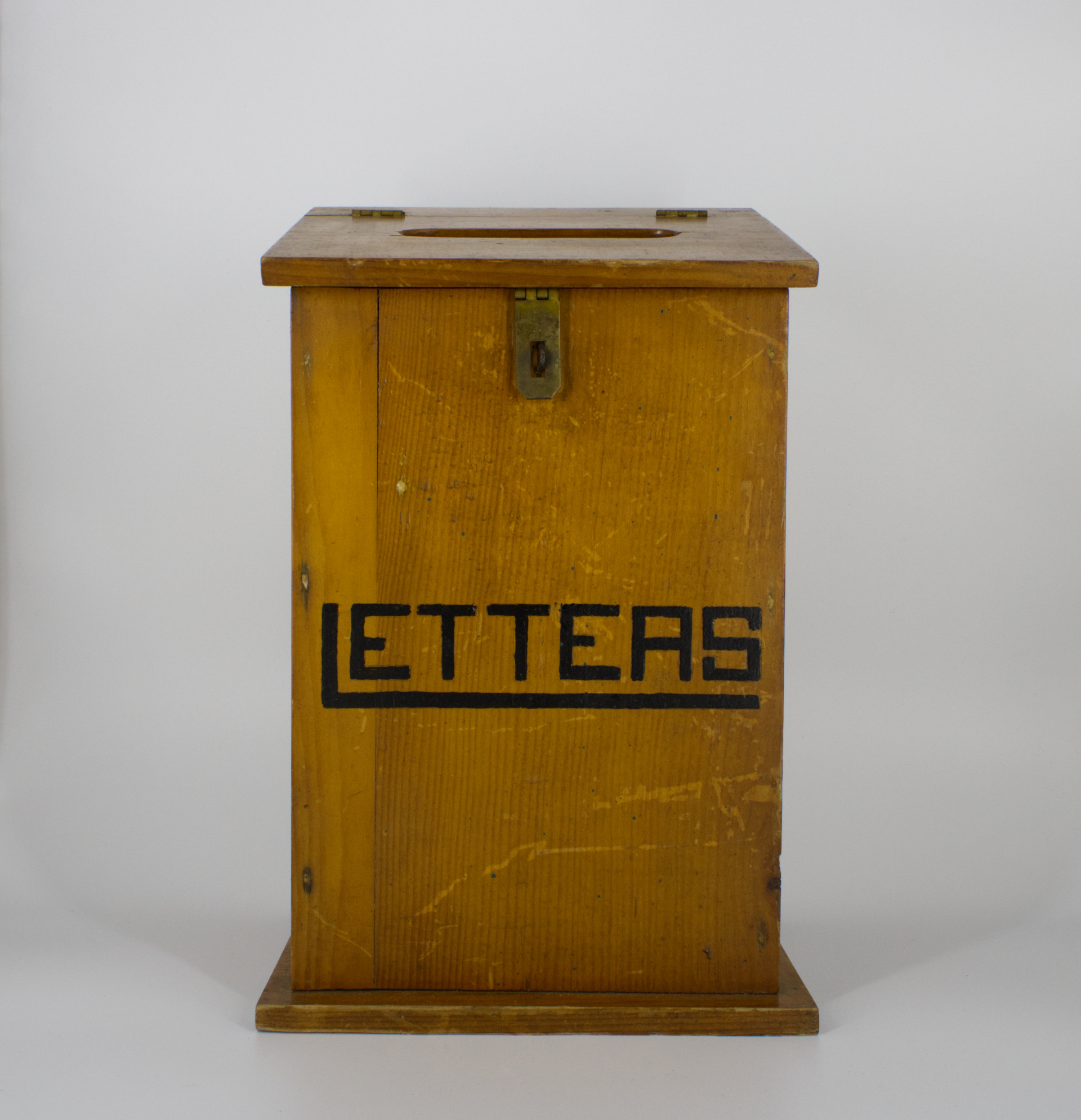
Mr. Collier's mailbox | Letters box |
Information about the object
Historical period
Unknown
Dimensions
Height: 38.20 cm. Width: 23.90 cm. Depth: 18.10 cm.
Classification
Furnishings and decoration -- Home accessories
Accession number
1987.1.1365
Division
Material culture -- Tools and equipment for communication -- Written communication
Collection
Evelyne Allard Landry
Donor
Evelyne Allard Landry
Category/theme
Description of the object
The object is made of varnished wood. A padlock secured the lid. The word "Letters" is written in black on the front of the box. It is unclear whether the object is handmade or industrially manufactured.
Value of the item
The object bears witness to the development of Acadian society in general. In this case, it shows the importance of the postal service for the Gaspé Peninsula, which is relatively isolated from the rest of Quebec.
The object also bears witness to a potentially Acadian family, the Collier family, according to testimonies (although this family is not commonly recognized as Acadian). This mailbox is believed to have belonged to a Mr. Collier, possibly a resident of the Maritime Provinces.
The object also bears witness to a potentially Acadian family, the Collier family, according to testimonies (although this family is not commonly recognized as Acadian). This mailbox is believed to have belonged to a Mr. Collier, possibly a resident of the Maritime Provinces.
Learn more
The postal service in the Gaspé Peninsula has had a long and turbulent history. In the 18th century, there were no roads connecting the Gaspé Peninsula to the rest of Canada, and mail was sent by schooner via a service that was frequently interrupted. The arrival of the Kempt Road in 1832 only temporarily alleviated these disruptions, as it remained impassable until the advent of the Matapédia Road in 1867. The second half of the 19th century also saw the emergence of ferries and railways, which facilitated the transport of goods, people, and mail. As coastal and forest villages developed in the 20th century, post offices sprang up in every township, sometimes located in general stores. In the 1960s, most of these offices closed as Canada Post centralized its operations.