
Download image

Evangeline souvenir doll | Apsute’gann
Information about the object
Historical period
1970
Dimensions
Height: 6 inches. Width: 5 inches.
Classification
Fine arts -- Mixed media
Accession number
1987.1.45
Division
Material culture -- Means of expression -- Decorative art
Collection
Evelyne Allard Landry
Donor
Evelyne Allard Landry
Category/theme
Description of the object
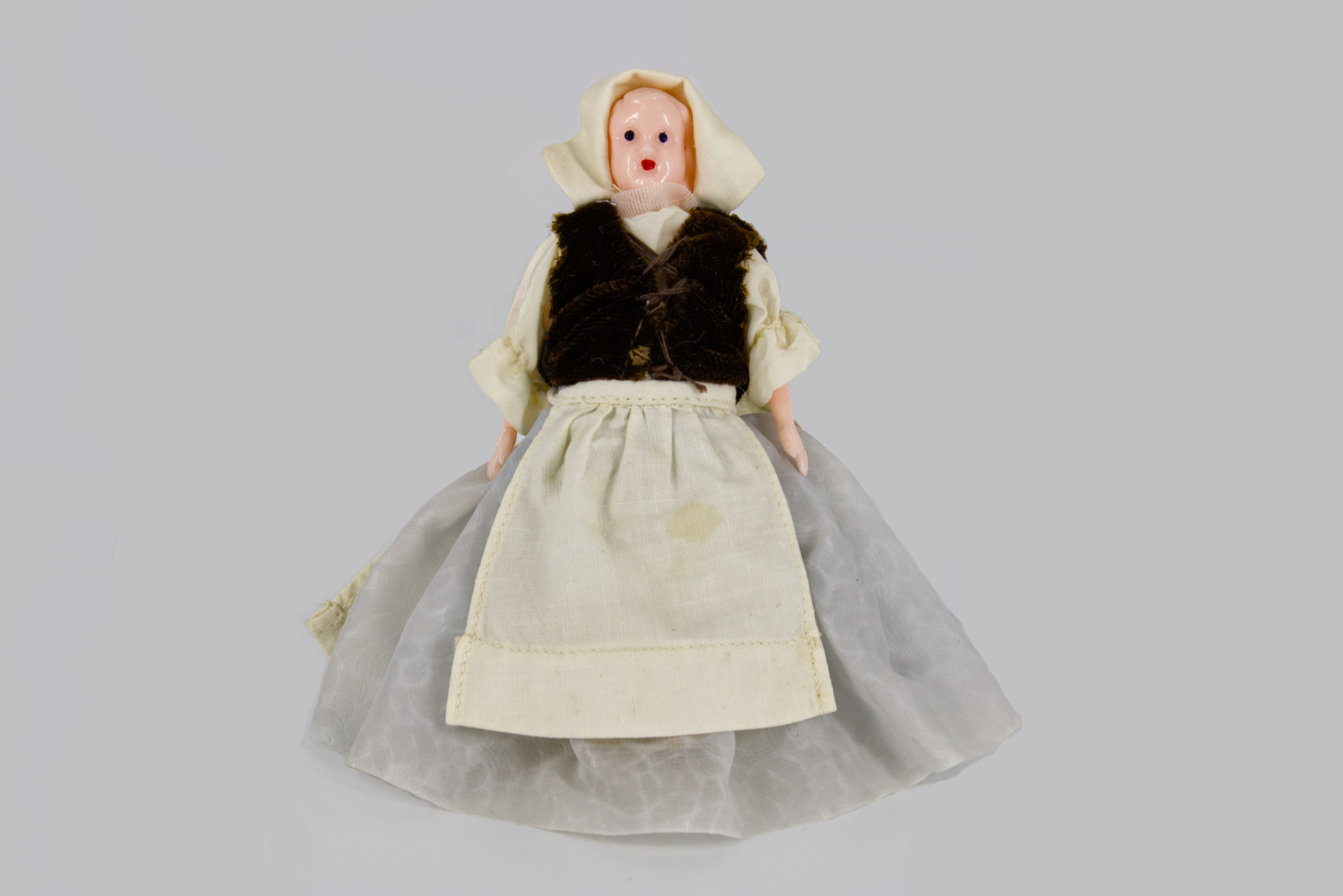
Commercially manufactured doll made of plastic and cotton, whose original clothing has been replaced to make it a representation of Evangeline in Acadian costume. White dress, hat, and small black jacket. The doll's costume was made by Évelyne Allard Landry in 1970.
Value of the item
The object bears witness to the traditional skills and practices of the Acadian people, as well as the development of tourism in Les Petites-Cadies around Acadian culture and traditions.
The object takes on additional value because it evokes a sense of Acadian pride, which is attributed to the Acadian Renaissance (1867-1960), a phenomenon of self-appropriation of Acadian culture by its heirs.
The object also bears witness to the expertise of Acadian women in textile processing, including sewing, weaving, embroidery, knitting, etc.
The object takes on additional value because it evokes a sense of Acadian pride, which is attributed to the Acadian Renaissance (1867-1960), a phenomenon of self-appropriation of Acadian culture by its heirs.
The object also bears witness to the expertise of Acadian women in textile processing, including sewing, weaving, embroidery, knitting, etc.
Learn more
The Acadian Renaissance (1867-1960) is a well-documented phenomenon that coincided with the beginning of Canadian Confederation until 1960. It affected the political, religious, cultural, economic, and educational spheres. (https://www.erudit.org/fr/revues/rs/2013-v54-n2-rs0809/1018283ar/)
Other Evangeline souvenir dolls were also produced elsewhere in Acadia (http://cfml.ci.umoncton.ca/1755-html/indexae3b.html?id=020102000&overlay=doc&identifier=002109&bd=CEA&lang=fr&style=G&admin=false&linking=). The myth of Evangeline inspired many intellectuals, authors, and members of the clergy to focus on national identity at the heart of the Acadian Renaissance. In addition, the symbol of Evangeline has also inspired other forms of art: paintings (such as T. Fred's Evangeline, 1863), statuettes, and plates, most of which are intended for commercial and tourist purposes. In this sense, Evangeline is a pan-Acadian symbol that rhymes with the creation of a common founding myth for the Acadian nation... and for tourism purposes! (https://www.erudit.org/en/journals/continuite/1900-v1-n1-continuite1055669/17392ac.pdf)
Other Evangeline souvenir dolls were also produced elsewhere in Acadia (http://cfml.ci.umoncton.ca/1755-html/indexae3b.html?id=020102000&overlay=doc&identifier=002109&bd=CEA&lang=fr&style=G&admin=false&linking=). The myth of Evangeline inspired many intellectuals, authors, and members of the clergy to focus on national identity at the heart of the Acadian Renaissance. In addition, the symbol of Evangeline has also inspired other forms of art: paintings (such as T. Fred's Evangeline, 1863), statuettes, and plates, most of which are intended for commercial and tourist purposes. In this sense, Evangeline is a pan-Acadian symbol that rhymes with the creation of a common founding myth for the Acadian nation... and for tourism purposes! (https://www.erudit.org/en/journals/continuite/1900-v1-n1-continuite1055669/17392ac.pdf)