
This work is protected by copyright and/or related rights. Its use requires the authorization of the rights holder(s).
Download image

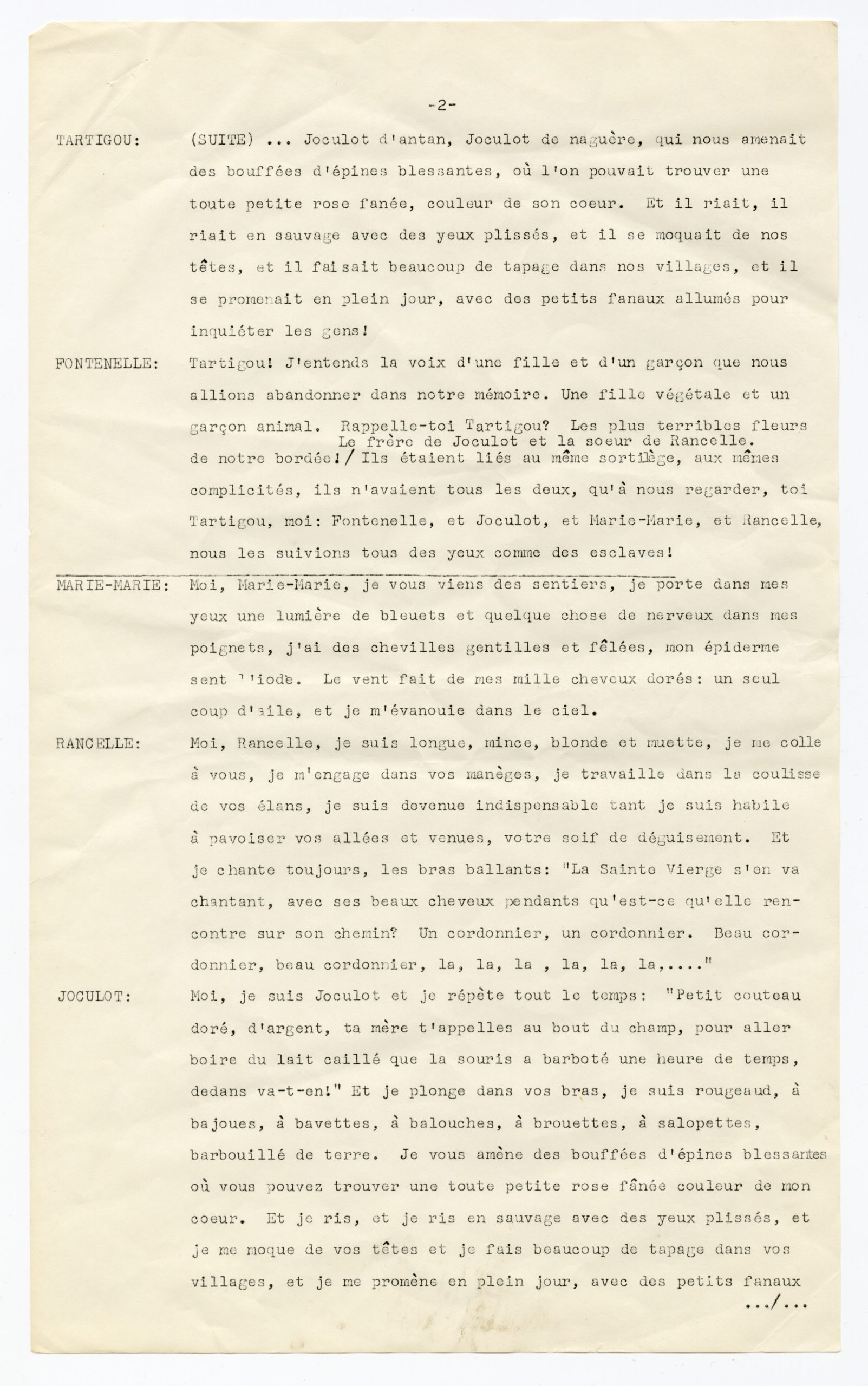
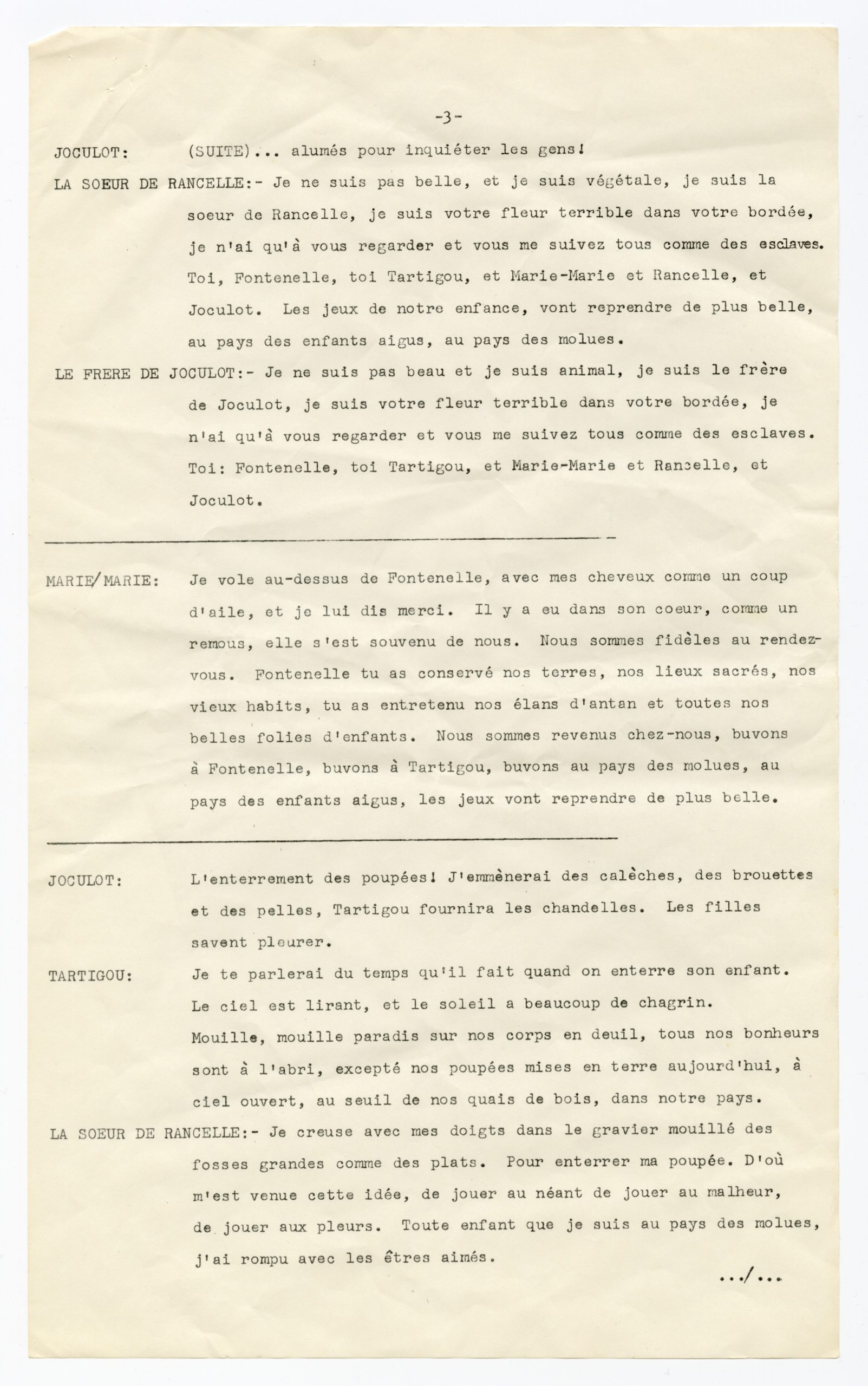
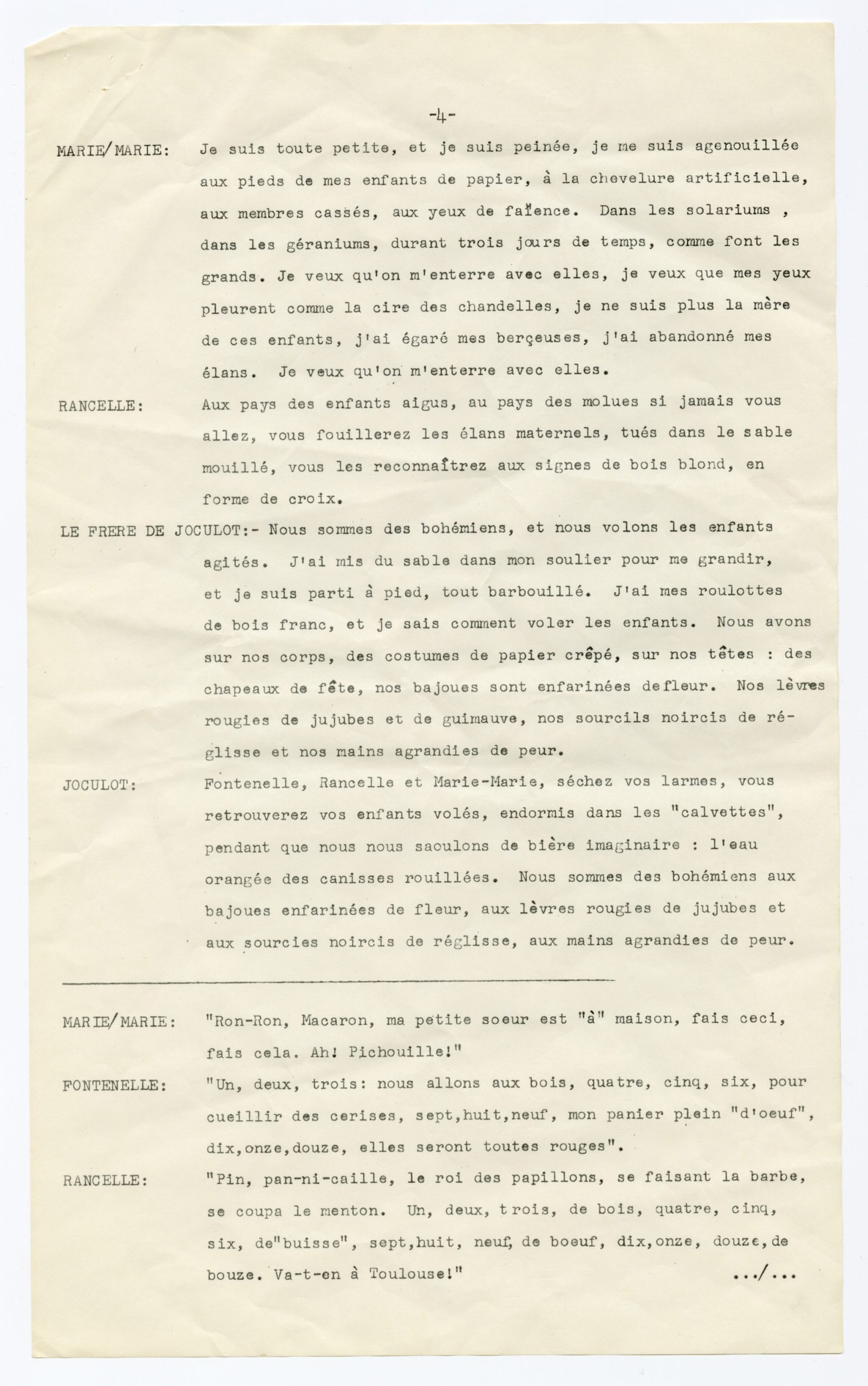

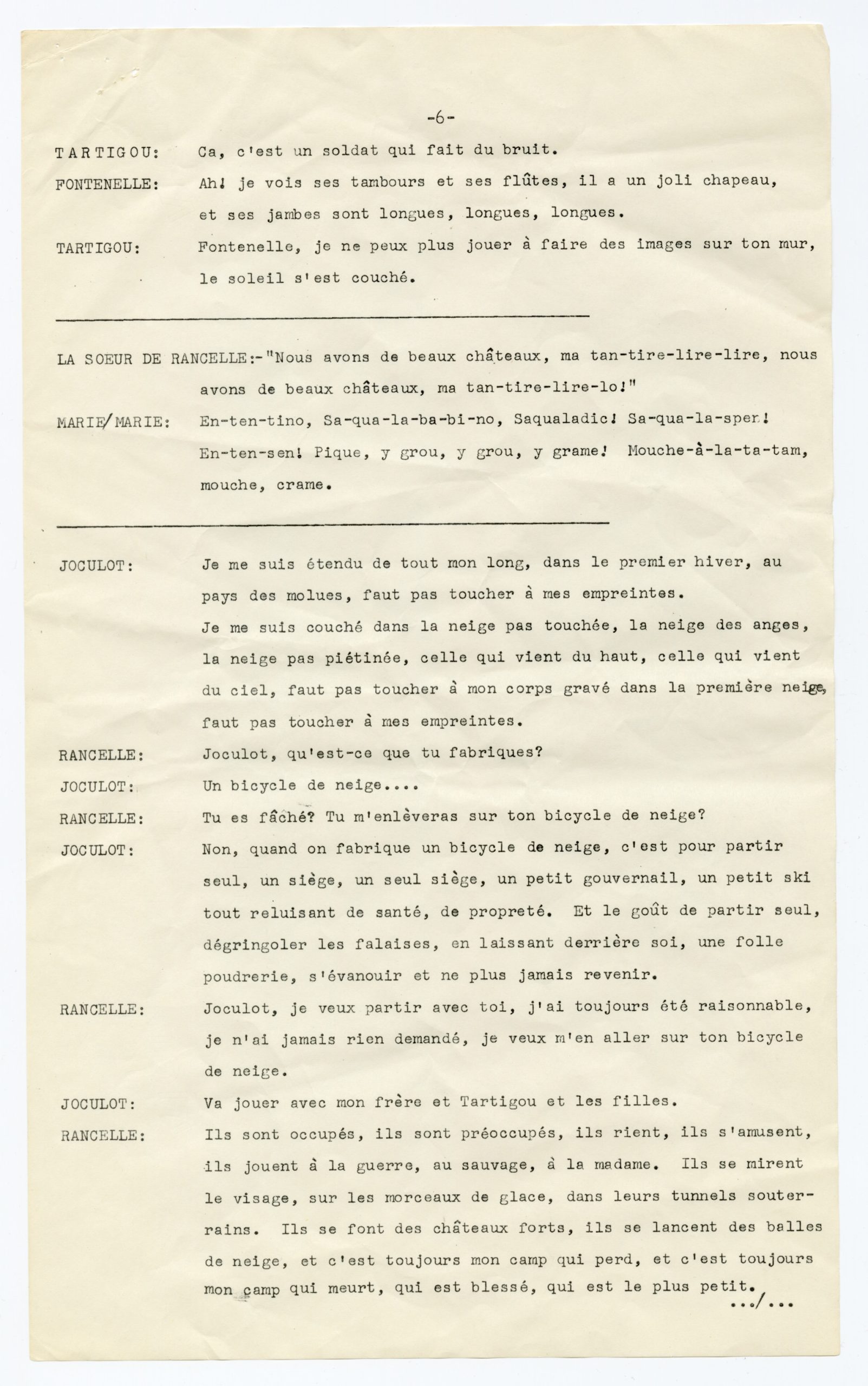
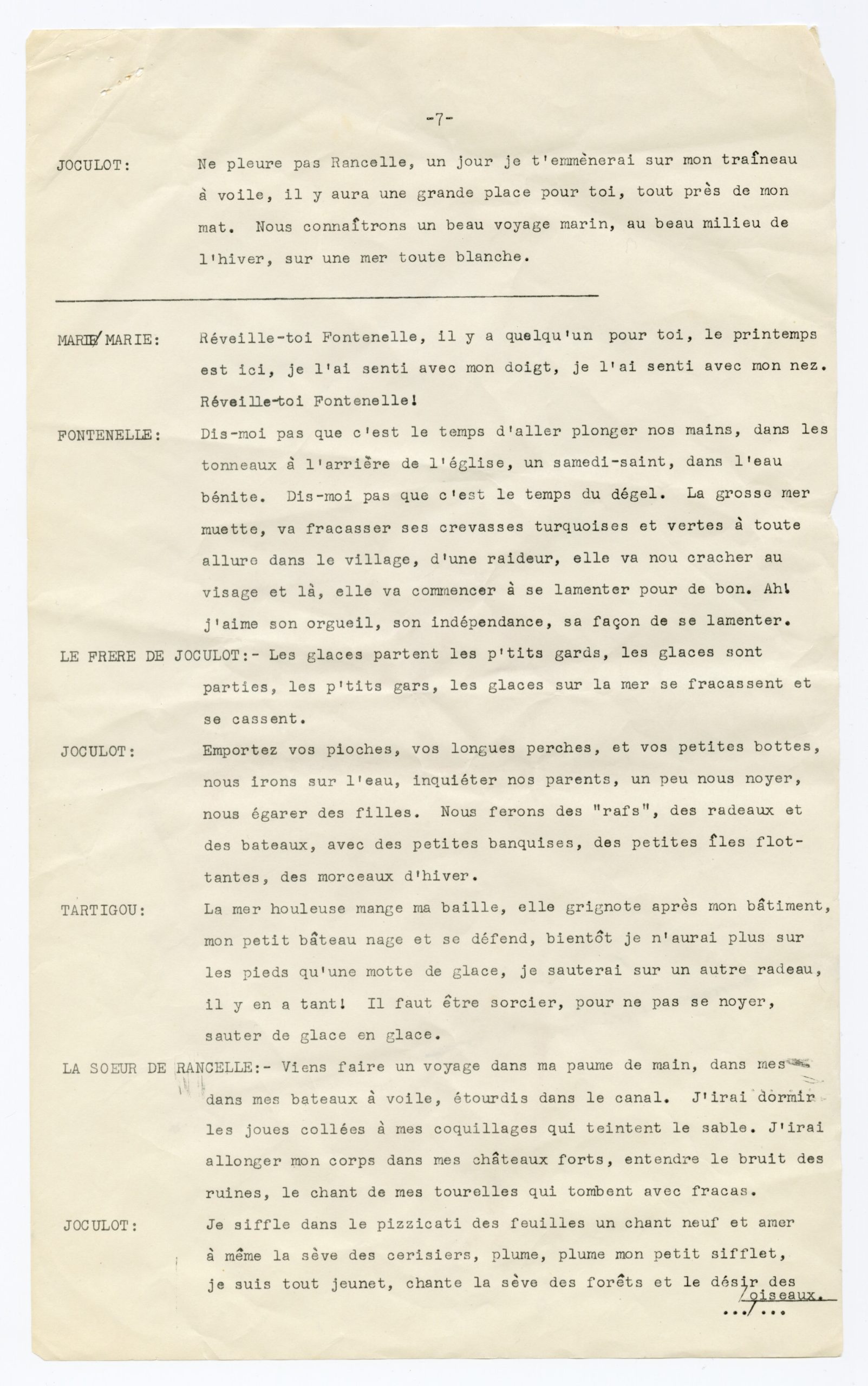
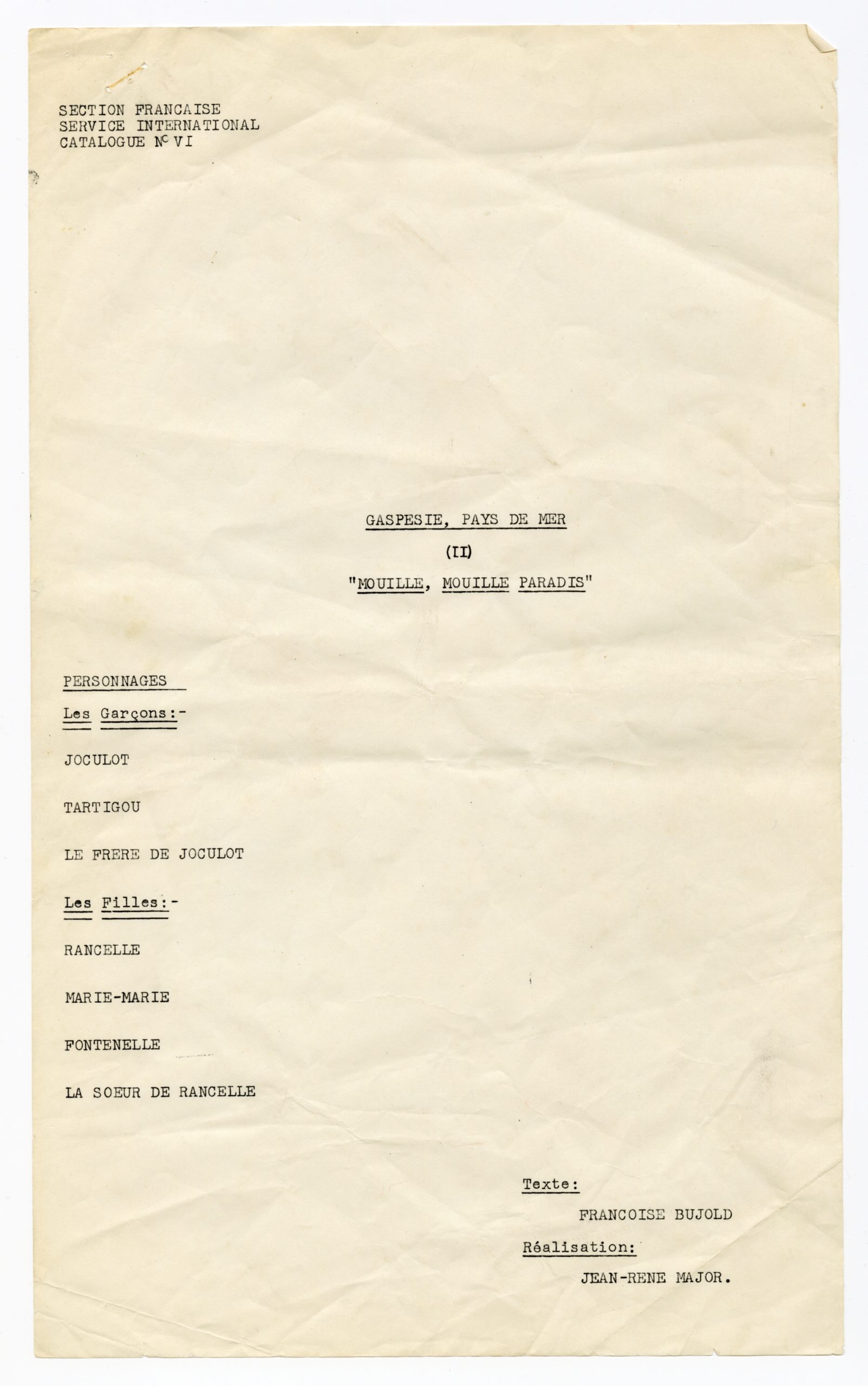
Play, Act II, by Françoise Bujold | Play, Act II |
Information about the object
Historical period
c. 1960
Dimensions
Height: 35 cm. Width: 21.40 cm.
Classification
Fine arts -- Theater
Accession number
1994.5.3
Division
Documents and archives -- Means of expression -- Pieces and documents
Collection
Marie-Josée Tommi
Donor
Marie-Josée Tommi
Category/theme
Description of the object
Text of a dramatic play broadcast on Radio Canada in 1960, according to the database. Eight typewritten pages on 11 x 17-inch sheets.
Photograph protected by copyright. Reproduction prohibited.
Photograph protected by copyright. Reproduction prohibited.
Value of the item
The object bears witness to the participation of people of Acadian origin in Quebec's artistic, political, and social effervescence. Indeed, the object bears witness to the work of Françoise Bujold, an Acadian artist from Bonaventure. Throughout her work, Françoise Bujold highlights the cultural characteristics of the Gaspé Peninsula, beginning with the communities that make up the region, the richness of the Gaspé language, and its territory. This document illustrates Françoise Bujold's artistic activities, particularly her playwriting, which dominated her output between 1955 and 1965 (https://fr.wikipedia.org/wiki/Fran%C3%A7oise_Bujold). At that time, she wrote scripts for Radio-Canada, including the famous Toi qui n'es pas né au bord de l'eau, as well as La Piouke and Un fou nu-pieds dans un village.
This play, whose manuscript focuses on the second act ("Mouille, mouille paradis"), is also accompanied by a heading indicating "Section française - service international - Catalogue no 6" without further details. It features characters who appear elsewhere in the artist's work, including Joculot, Tartigou, Rancelle, and Fontenelle. The play appears to be incomplete. It is accompanied by the name of a director, Jean-René Major.
This document illustrates Françoise Bujold's artistic activities, particularly her playwriting, which dominated her output between 1955 and 1965 (https://fr.wikipedia.org/wiki/Fran%C3%A7oise_Bujold). At that time, she wrote scripts for Radio-Canada, including the famous Toi qui n'es pas né au bord de l'eau, as well as La Piouke and Un fou nu-pieds dans un village. This manuscript appears to be titled Gaspésie, pays de mer, but this does not seem to correspond to any official publication by Françoise Bujold.
The subtitle is "Mouille, mouille paradis" (Wet, wet paradise), which corresponds to a French nursery rhyme about rain dating back to at least the 19th century (https://fr.wikisource.org/wiki/French_Nursery_Rhymes/Un_temps_de_pluie). A poem with this title was also published in the book Piouke fille unique by Parti Pris (1982), but it has no connection with the play.
Finally, the document is valuable in that the characters in the play represent places in the Gaspé Peninsula: Rancelle (Laurencelle Road between Cap-des-Rosiers and Cap-aux-Os) (http://archives.museedelagaspesie.ca/album/transport/p57_15_10__da__tail_laurencelle__-_72/), Tartigou (river in Saint-Ulric), Fontenelle (hamlet near the Dartmouth River), and Joculot (for "chaculot," referring to the youngest child in a family; this name is found in Paspébiac, among other places).
This play, whose manuscript focuses on the second act ("Mouille, mouille paradis"), is also accompanied by a heading indicating "Section française - service international - Catalogue no 6" without further details. It features characters who appear elsewhere in the artist's work, including Joculot, Tartigou, Rancelle, and Fontenelle. The play appears to be incomplete. It is accompanied by the name of a director, Jean-René Major.
This document illustrates Françoise Bujold's artistic activities, particularly her playwriting, which dominated her output between 1955 and 1965 (https://fr.wikipedia.org/wiki/Fran%C3%A7oise_Bujold). At that time, she wrote scripts for Radio-Canada, including the famous Toi qui n'es pas né au bord de l'eau, as well as La Piouke and Un fou nu-pieds dans un village. This manuscript appears to be titled Gaspésie, pays de mer, but this does not seem to correspond to any official publication by Françoise Bujold.
The subtitle is "Mouille, mouille paradis" (Wet, wet paradise), which corresponds to a French nursery rhyme about rain dating back to at least the 19th century (https://fr.wikisource.org/wiki/French_Nursery_Rhymes/Un_temps_de_pluie). A poem with this title was also published in the book Piouke fille unique by Parti Pris (1982), but it has no connection with the play.
Finally, the document is valuable in that the characters in the play represent places in the Gaspé Peninsula: Rancelle (Laurencelle Road between Cap-des-Rosiers and Cap-aux-Os) (http://archives.museedelagaspesie.ca/album/transport/p57_15_10__da__tail_laurencelle__-_72/), Tartigou (river in Saint-Ulric), Fontenelle (hamlet near the Dartmouth River), and Joculot (for "chaculot," referring to the youngest child in a family; this name is found in Paspébiac, among other places).
Learn more
Françoise Bujold (1933-1981) was the daughter of Oscar Bujold and Elise Grenier. She was a multidisciplinary artist from Bonaventure, a writer, poet, and artist. Along with Marie Anastasie, she was the first woman to study at the Institut des arts graphiques de Montréal. She studied graphic arts with Albert Dumouchel, graphic design and layout with Gilles Robert, and color separation with Arthur Gladu. During her lifetime, she published nine collections of poetry, five articles, and wrote short stories. She hosted and exhibited at the Percé Art Center for nearly twenty years. She also gave engraving workshops with the Mi'gmaqs of Gesgapegiag, which resulted in two collections: Une fleur debout dans un canot (1962) and La naissance du soleil (1966). She also made a film with Jacques Godbout featuring the Mi'gmaqs of Gesgapegiag, Le monde va nous prendre pour des sauvages. In the final years of her career, in 1979, she stayed in Miguasha to draw fossils. She died in January 1981.
One name appears at the bottom of the title page: Jean-René Major, director. Jean-René Major is a Quebec author and writer who published Où nos pas nous attendent (1957), among other works. Little information is available about this author.
One name appears at the bottom of the title page: Jean-René Major, director. Jean-René Major is a Quebec author and writer who published Où nos pas nous attendent (1957), among other works. Little information is available about this author.