
Download image

Sinew Canoe Bench | Ugt’pun
Information about the object
Historical period
c. 1890–1950
Dimensions
Height: 58 cm. Width: 37 cm. Length: 50 cm.
Classification
Tools and equipment -- Hunting and fishing
Accession number
2015.1.20
Division
Material culture -- Armaments, science, and technology -- Equipment
Collection
Richard Gauthier
Donor
Richard Gauthier
Category/theme
Description of the object
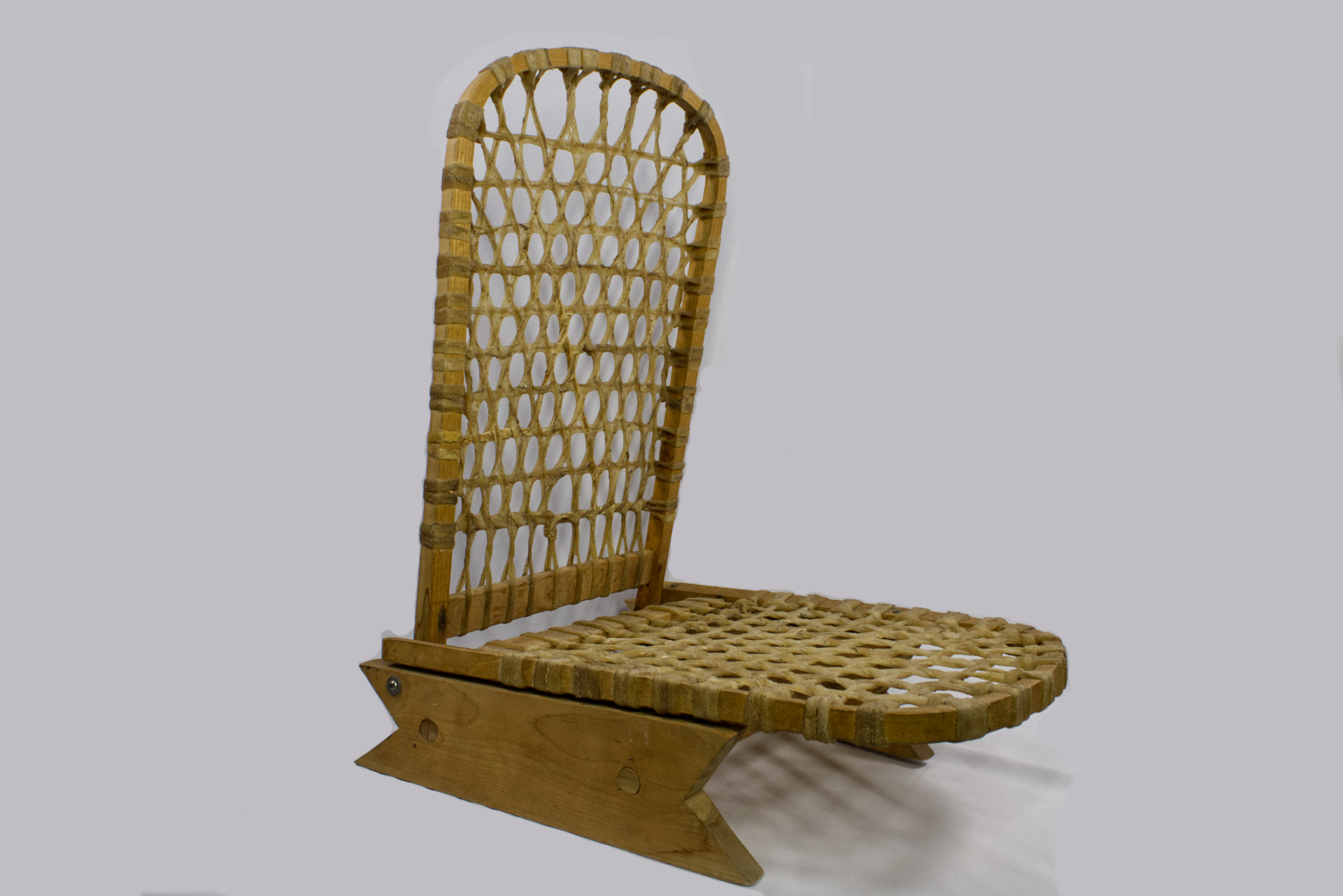
Foldable, low-profile bench with a seat and backrest woven with babiche (leather straps) in the style of snowshoes.
Value of the item
The object reflects First Nations expertise in the manufacture of babiche. According to the Canadian Encyclopedia, "Babiche is a type of traditional cord made by Indigenous peoples from strips of elk or deer hide. It is used, among other things, to weave snowshoes and fishing nets, and to attach drum skins and other similar objects. Although the term appears to be of French Canadian origin, it comes from an Algonquian word meaning "rope" (ababich in Mi'kmaq) or "thread" (assabâbish in Ojibwe)." Caribou sinew is also used to make this babiche.
In addition, the object bears witness to the development of Gaspé society in general around a particular activity: sport fishing. According to available information, the shape of this bench is identical to that of the canoe benches commonly used by sportsmen in the Gaspé Peninsula and eastern Canada when fishing for Atlantic salmon. The bench may have been made by the Wendats of Wendake, near Quebec City.
In addition, the object bears witness to the development of Gaspé society in general around a particular activity: sport fishing. According to available information, the shape of this bench is identical to that of the canoe benches commonly used by sportsmen in the Gaspé Peninsula and eastern Canada when fishing for Atlantic salmon. The bench may have been made by the Wendats of Wendake, near Quebec City.
Learn more
According to the Canadian Encyclopedia, "Indigenous women make babiche by first soaking the animal's hide to remove the hair and flesh. They then stretch the hide to dry it and cut it into long, narrow strips. These strips are what is known as 'babiche'. The characteristics of babiche (color, thickness, strength) vary depending on the animal used, particularly whether it is terrestrial or aquatic. Animal tendons and intestines can also be used to make babiche." Here is a short video from the Innu Nation explaining how babiche is made: http://www.nametauinnu.ca/fr/nomade/detail/47/33