
Download image
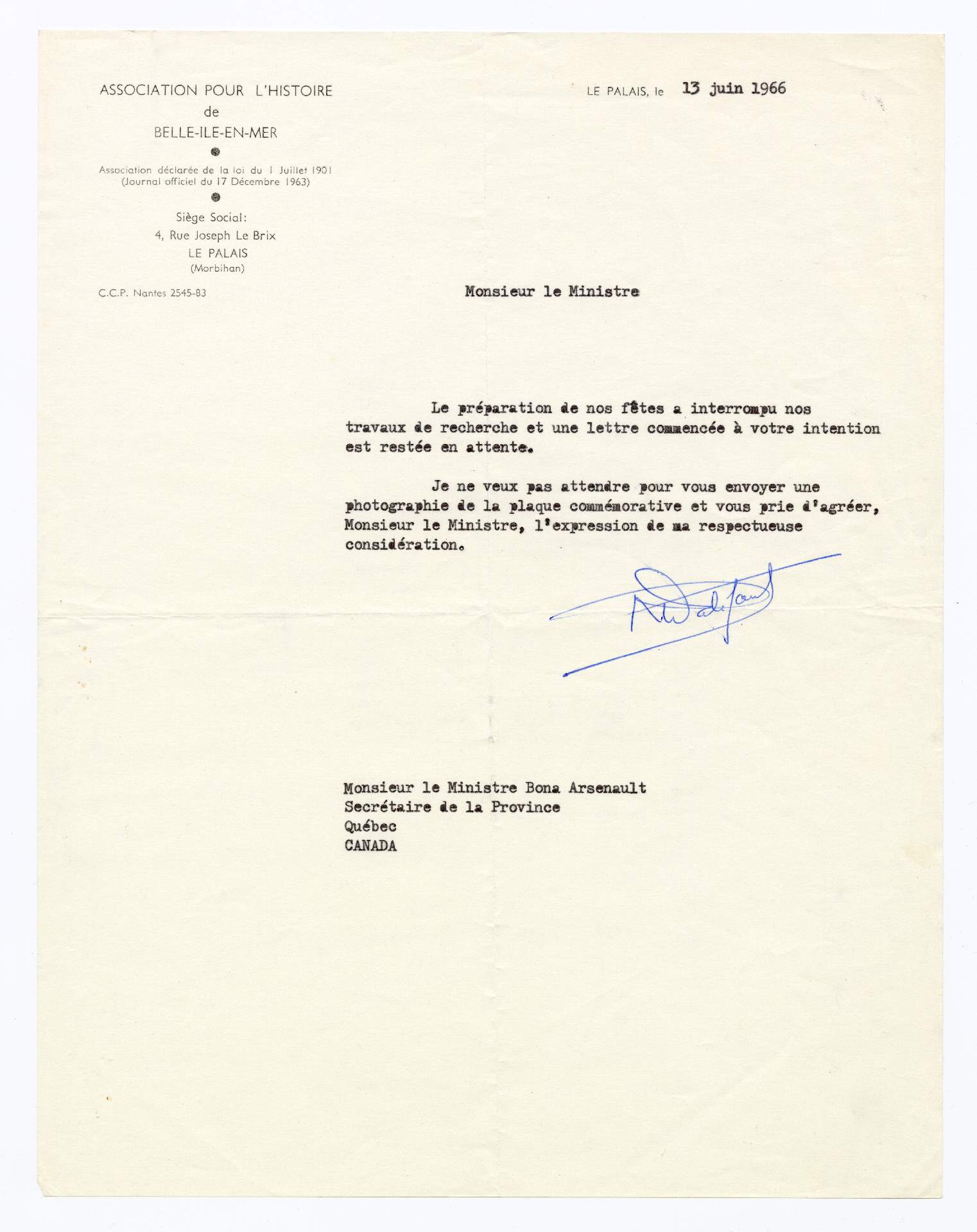

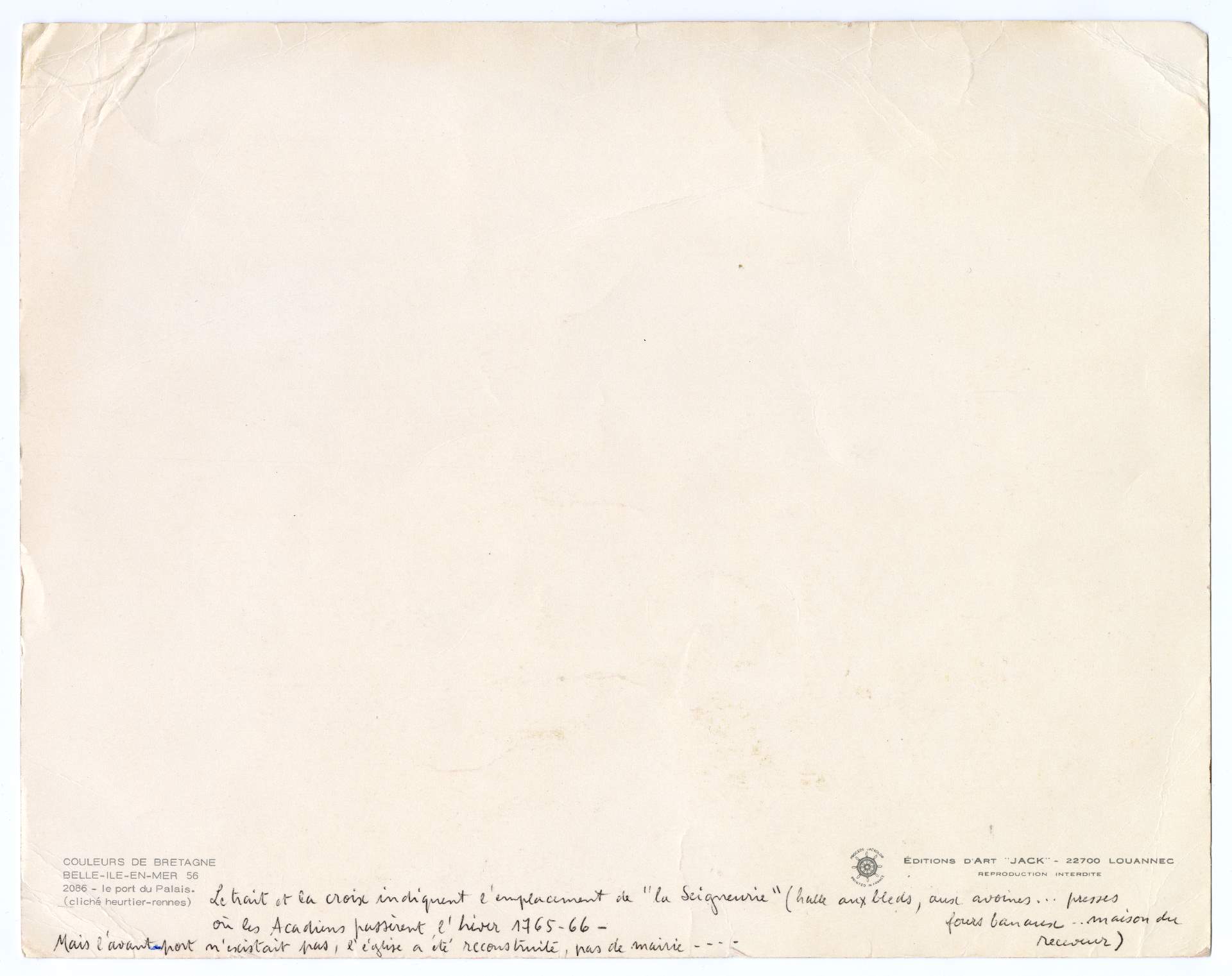

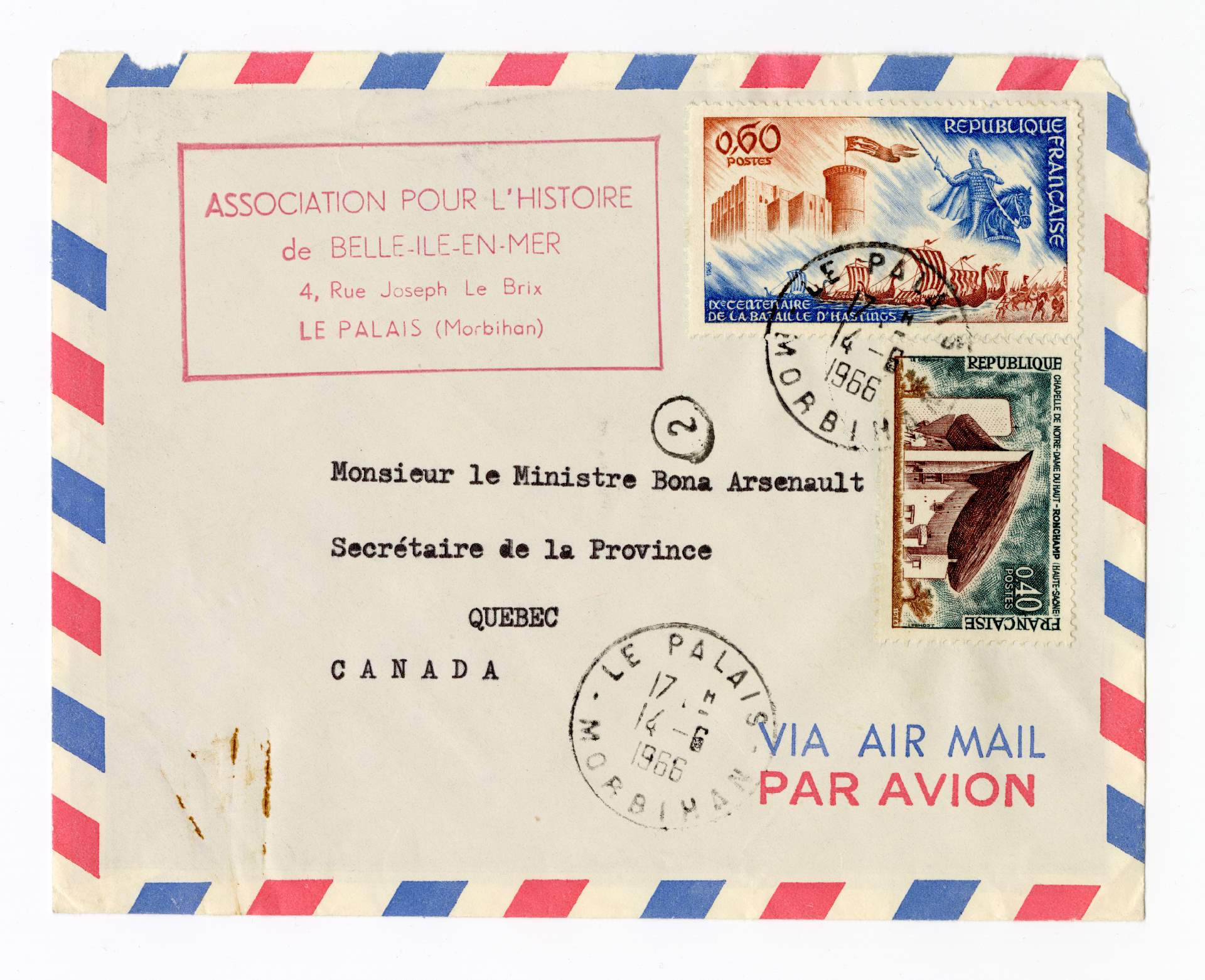
Correspondence (3 letters) between Bona Arsenault and the Association for the History of Belle-Isle-en-Mer | Correspondence (3 letters) |
Information about the object
Historical period
1966
Dimensions
Unknown
Classification
Communications -- Document
Accession number
P1.1c.8
Division
Documents and archives -- Means of expression -- Pieces and documents
Collection
Bona Arsenault
Donor
Bona Arsenault
Category/theme
Description of the object
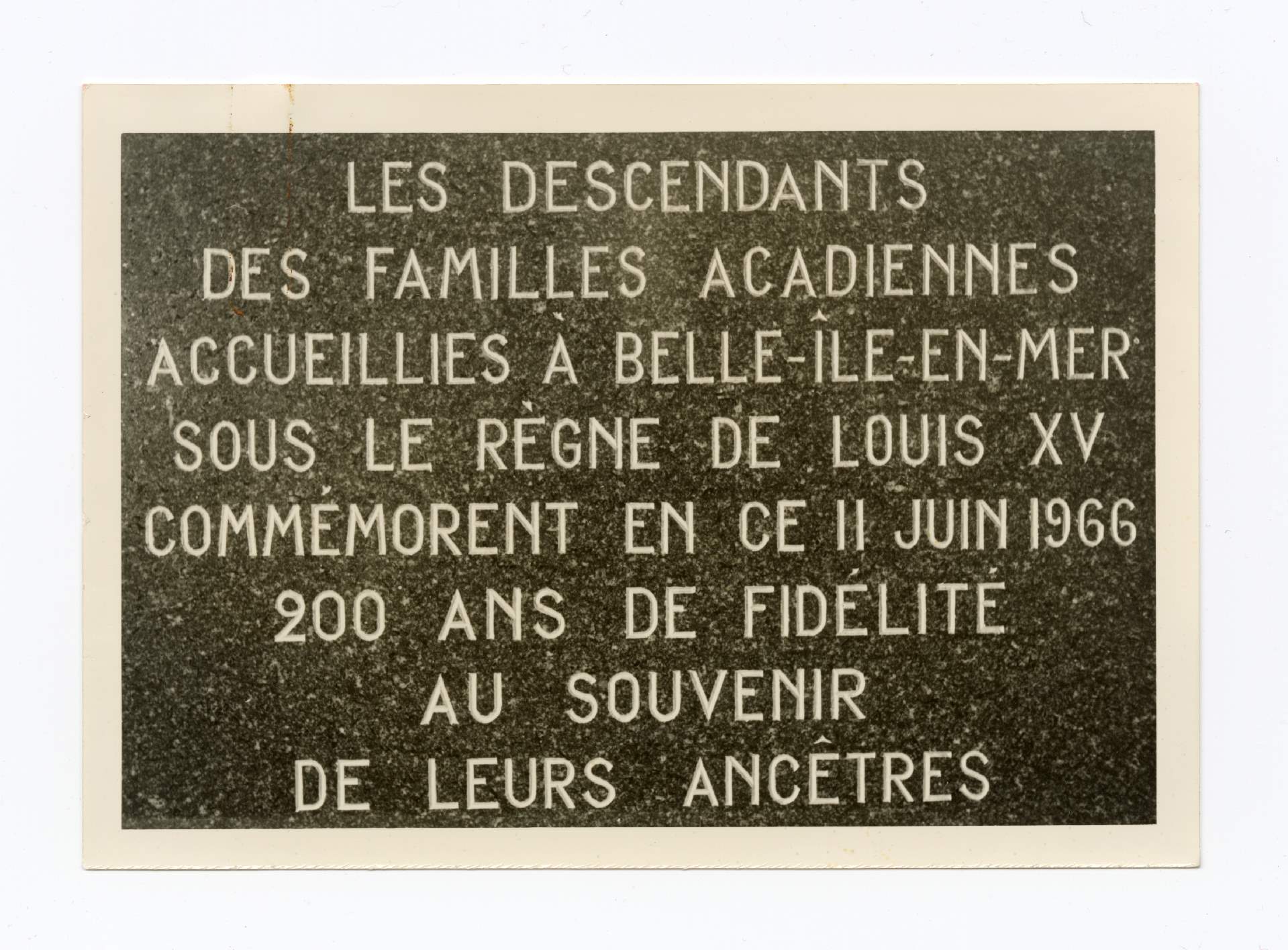
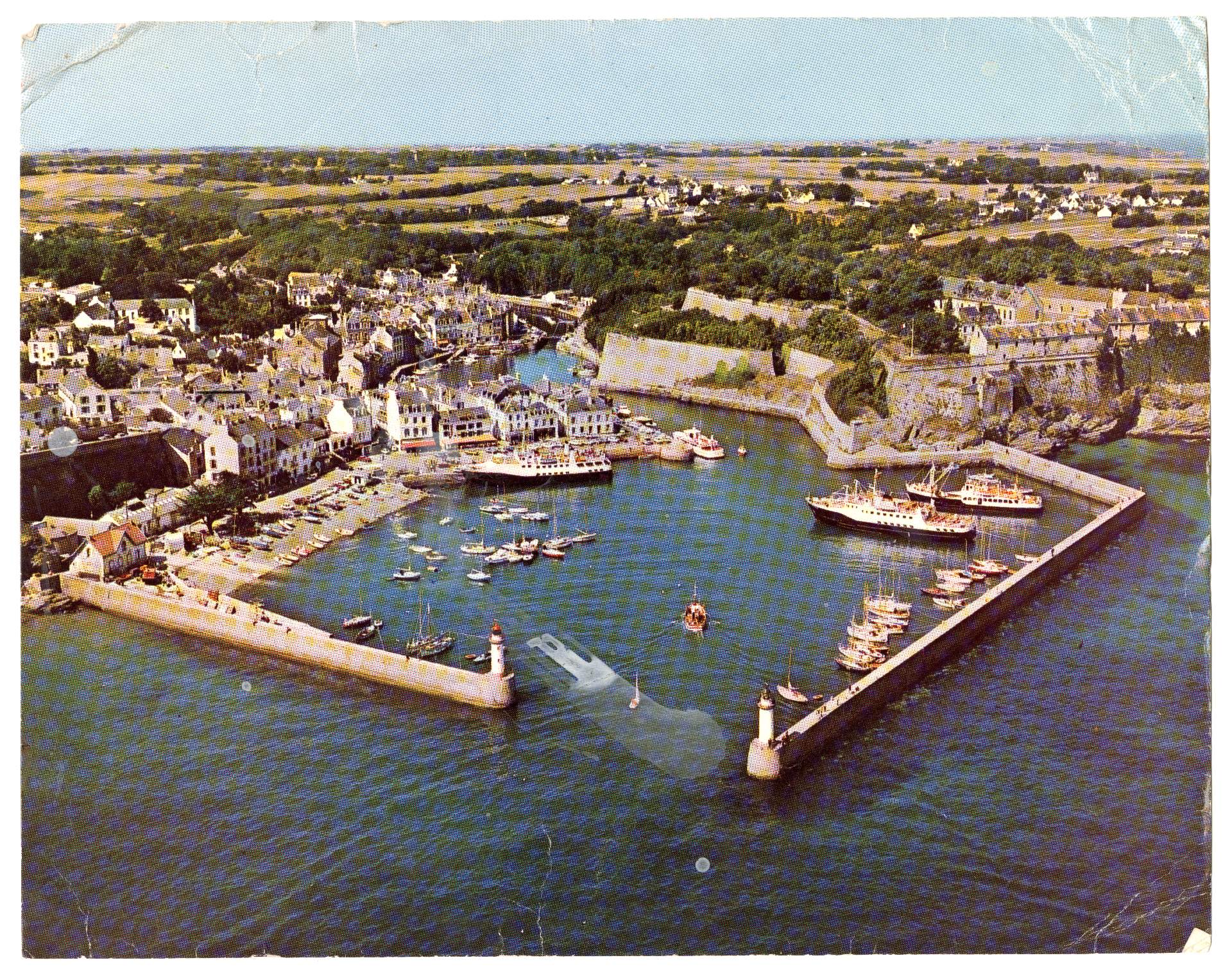
Documentary collection consisting of the following items: 1) A photo of the commemorative plaque; 2) An illustration of Belle-Île-en-Mer; 3) Correspondence on this subject.
Value of the item
This object bears witness to the participation of people of Acadian origin in Quebec's artistic, political, and social effervescence. More specifically, this document bears witness to the life of politician Bona Arsenault (1903-1993), a native of Thivierge (Bonaventure). Bona Arsenault is known for his work as a federal member of Parliament for the riding of Bonaventure and for his genealogical research related to Acadia. This document focuses on the author's genealogical work, much of which has been published. Bona Arsenault oversaw the writing of numerous registers for the Gaspé Peninsula, including those for Nouvelle, Saint-Omer, Carleton, Maria, New Richmond, Caplan, Bonaventure, and Paspébiac. He also published several works on Acadian genealogy.
In addition, the correspondence bears witness to the development of Acadian society in terms of knowledge. Bona Arsenault's work was also important for certain satellite societies, including that of Belle-Isle-en-Mer, where Acadians were deported following the Great Upheaval.
Furthermore, this document bears witness to the ties that unite the Petites-Cadies through genealogy. Genealogical societies were formed throughout Quebec to meet a need for greater knowledge. Sometimes focused on a particular surname, region (such as the Gaspé Peninsula), or nation (such as the Acadians), these societies were of great importance in the appropriation of Quebec culture. Here, the historical society in question is more French in nature and bears witness to the links between the Petites-Cadies and the various Acadian settlements around the world.
In addition, the correspondence bears witness to the development of Acadian society in terms of knowledge. Bona Arsenault's work was also important for certain satellite societies, including that of Belle-Isle-en-Mer, where Acadians were deported following the Great Upheaval.
Furthermore, this document bears witness to the ties that unite the Petites-Cadies through genealogy. Genealogical societies were formed throughout Quebec to meet a need for greater knowledge. Sometimes focused on a particular surname, region (such as the Gaspé Peninsula), or nation (such as the Acadians), these societies were of great importance in the appropriation of Quebec culture. Here, the historical society in question is more French in nature and bears witness to the links between the Petites-Cadies and the various Acadian settlements around the world.
Learn more
Bona Arsenault was born in Thivierge (Bonaventure) on October 4, 1903, to Joseph Georges Arsenault and Marcelline Gauthier, both of Acadian descent.
He first studied at the Académie de Bonaventure and the School of Social, Political, and Economic Sciences at Laval University. He also took courses in administration and psychology at the University of Connecticut.
On May 6, 1926, he married Blandine Bernard, with whom he had eight children. In 1973, he married Lisette Fortier, daughter of Arthur Fortier, notary, and Aline Moffat.
In Quebec City, he first worked in the press, where he held various administrative positions: "Le Journal" (1932-1939) and "L'Événement-Journal" (1939-1941). From 1941 to 1953, he worked in the insurance sector, notably at the Insurance Company of Canada and Pratte & Côté.
Politically, Bona Arsenault first ran as a Conservative candidate in the provincial elections of 1931 and 1935. He was also defeated in the federal elections of 1940. He was first elected as an independent candidate to the House of Commons in Bonaventure in 1945. Elected under the Liberal banner in 1949, he was defeated in the 1957 federal election.
In 1960, he made the leap into provincial politics and became the Liberal member for the county of Matapédia. In the midst of the Quiet Revolution, he was part of Jean Lesage's "dream team" and held the positions of Minister of Lands and Forests (1960-1962), Minister of Fisheries and Hunting (1962-1963), and Provincial Secretary (1963-1966). Bona Arsenault was re-elected in 1970 and 1973, but was defeated in 1976 with the election of the Parti Québécois.
Alongside his political career, Bona Arsenault pursued a career as an author, publishing several books and articles on the history of the Acadians: "L'Acadie des ancêtres" (1955), "Histoire des Acadiens" (1966), "Louisbourg 1713-1758" (1971), etc. He was also responsible for the television series "Acadiana" on CHAU-TV and the publication of the registers of numerous parishes in Baie-des-Chaleurs.
During his career, Bona Arsenault received numerous awards: honorary member of the Maison acadienne-française de la Louisiane (1955), honorary doctorates from the universities of Bathurst and Moncton, Medal of the Order of Canada (1981), Order of Forestry Merit (1985), Officer of the Order of La Pléiade (1982). At the regional level, his work on the history and genealogy of the Acadians also earned him the Prix du Mérite culturel gaspésien (1984).
Bona Arsenault died on July 4, 1993, in Quebec City at the age of 89. Several Gaspé political figures attended his funeral at the church in Bonaventure to pay their respects: Gérard D. Lévesque, Albert Béchard, and Alexandre Cyr. His grandson, goalie Patrick Roy, was also in attendance. (http://archives.museedelagaspesie.ca/album/personnage/p57_3a_93_2/)
He first studied at the Académie de Bonaventure and the School of Social, Political, and Economic Sciences at Laval University. He also took courses in administration and psychology at the University of Connecticut.
On May 6, 1926, he married Blandine Bernard, with whom he had eight children. In 1973, he married Lisette Fortier, daughter of Arthur Fortier, notary, and Aline Moffat.
In Quebec City, he first worked in the press, where he held various administrative positions: "Le Journal" (1932-1939) and "L'Événement-Journal" (1939-1941). From 1941 to 1953, he worked in the insurance sector, notably at the Insurance Company of Canada and Pratte & Côté.
Politically, Bona Arsenault first ran as a Conservative candidate in the provincial elections of 1931 and 1935. He was also defeated in the federal elections of 1940. He was first elected as an independent candidate to the House of Commons in Bonaventure in 1945. Elected under the Liberal banner in 1949, he was defeated in the 1957 federal election.
In 1960, he made the leap into provincial politics and became the Liberal member for the county of Matapédia. In the midst of the Quiet Revolution, he was part of Jean Lesage's "dream team" and held the positions of Minister of Lands and Forests (1960-1962), Minister of Fisheries and Hunting (1962-1963), and Provincial Secretary (1963-1966). Bona Arsenault was re-elected in 1970 and 1973, but was defeated in 1976 with the election of the Parti Québécois.
Alongside his political career, Bona Arsenault pursued a career as an author, publishing several books and articles on the history of the Acadians: "L'Acadie des ancêtres" (1955), "Histoire des Acadiens" (1966), "Louisbourg 1713-1758" (1971), etc. He was also responsible for the television series "Acadiana" on CHAU-TV and the publication of the registers of numerous parishes in Baie-des-Chaleurs.
During his career, Bona Arsenault received numerous awards: honorary member of the Maison acadienne-française de la Louisiane (1955), honorary doctorates from the universities of Bathurst and Moncton, Medal of the Order of Canada (1981), Order of Forestry Merit (1985), Officer of the Order of La Pléiade (1982). At the regional level, his work on the history and genealogy of the Acadians also earned him the Prix du Mérite culturel gaspésien (1984).
Bona Arsenault died on July 4, 1993, in Quebec City at the age of 89. Several Gaspé political figures attended his funeral at the church in Bonaventure to pay their respects: Gérard D. Lévesque, Albert Béchard, and Alexandre Cyr. His grandson, goalie Patrick Roy, was also in attendance. (http://archives.museedelagaspesie.ca/album/personnage/p57_3a_93_2/)