
Download image

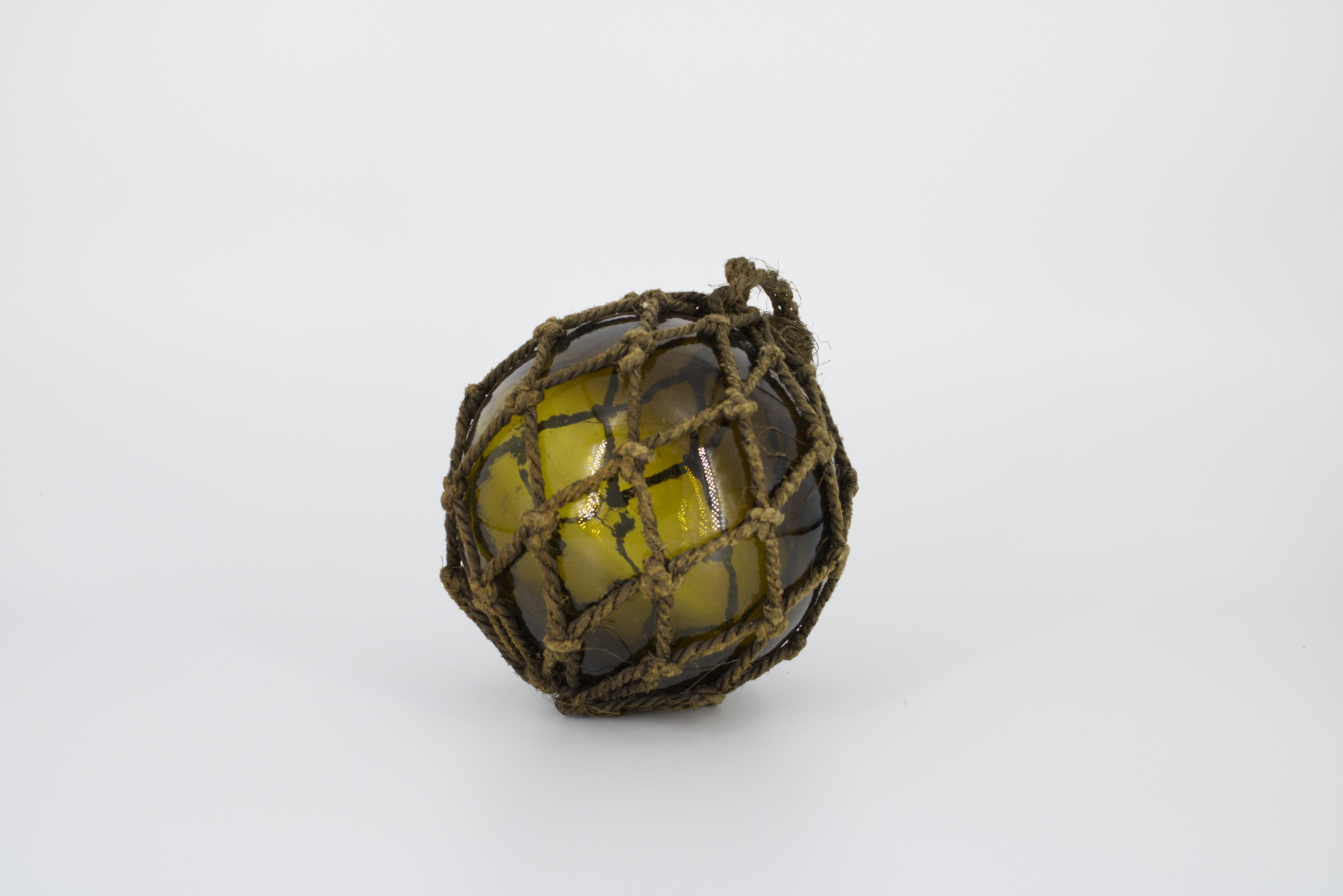
Glass keel | Glass fishing buoy |
Information about the object
Historical period
Unknown
Dimensions
Unknown
Classification
Tools and equipment -- Hunting and fishing
Accession number
1987.1.1168
Division
Material culture -- Tools and equipment for processing raw materials -- Fishing and trapping
Collection
Evelyne Allard Landry
Donor
Evelyne Allard Landry
Category/theme
Description of the object
Keel, also known as a "float." Part of a set comprising three circular cork buoys. The keel is made of glass, which is quite unique and attests to the age of the object.
Value of the item
The object reflects a skill traditionally associated with or practiced by the people of Gaspé and Acadia, specifically fishing. Glass floats, usually colored, were used to keep nets afloat during fishing. They are also called "trawl balls" and are usually woven into a net using marine knots. (https://www.decoration-marine.com/flotteurs/250-flotteur-de-peche-en-verre-2.html).
A reference to the setting of nets ("trawls") attached by ropes and buoys for cod fishing can be found in Treasure Trove in the Gaspé, Margaret Grant Mc Whirter, 1919, p. 125. (https://numerique.banq.qc.ca/patrimoine/details/52327/1983441)
A reference to the setting of nets ("trawls") attached by ropes and buoys for cod fishing can be found in Treasure Trove in the Gaspé, Margaret Grant Mc Whirter, 1919, p. 125. (https://numerique.banq.qc.ca/patrimoine/details/52327/1983441)
Learn more
In France, sailor-knotted glass balls were used as floats on flag buoys (as flotation devices), on lines (ropes connecting the buoy to nets or traps) to indicate the direction of the current and allow for better "lifting," and on the nets themselves to stabilize them vertically at the bottom of the water. To moor them and protect them from impact, fishermen would "sailor" them during the winter, wrapping them in a "rope" (pronounced "boutte" = cordage) made of natural hemp. As hemp is not resistant to moisture, these fishing floats were then "coaltared" (dipped in liquid bitumen) to protect them..." (http://www.lecomptoir-mogueriec.fr/produits/flotteurs-de-peche-en-verre-moules-artisanalement-recouvert-dun-filet-en-nouages-marins/)