
Download image

Wicker demijohn | Pu’tai
Information about the object
Historical period
c. 1900–1950
Dimensions
Height: 42 cm
Classification
Tools and equipment -- Food production
Accession number
1987.1.526
Division
Material culture -- Tools and equipment for processing raw materials -- Food processing
Collection
Evelyne Allard Landry
Donor
Evelyne Allard Landry
Category/theme
Description of the object
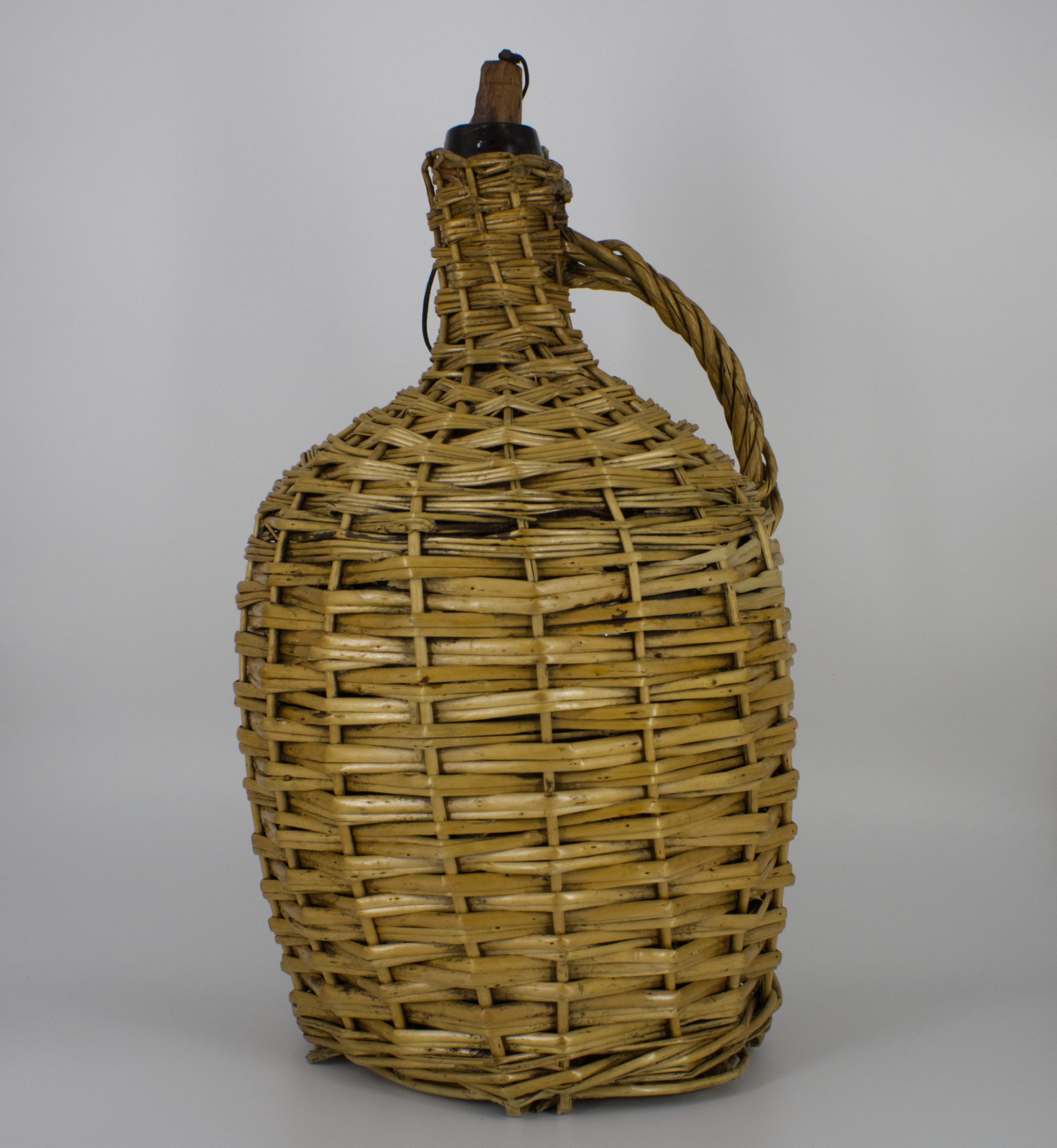
This specific type of container is called a "demijohn," which is a large glass bottle with a wicker handle. The bottle is made of thick glass, has a rounded shape, and a short neck.
Value of the item
The object bears witness to the traditional knowledge and practices of the Acadian people and the development of Acadian and Gaspé culinary arts. More specifically, it provides insight into the practices of preserving and storing liquids. The demijohn can hold up to 50 liters of alcohol, such as brandy, wine, cider, and spirits, as well as oils and vinegars.
In addition, the object illustrates basketry work, first carried out by First Nations peoples in the manufacture of baskets and other containers. However, it should be noted that this may not be traditional Mi'kmaq basketry, but rather a commercial product. It is common for demijohns to be woven from wicker. (https://vitrinelinguistique.oqlf.gouv.qc.ca/fiche-gdt/fiche/17583856/dame-jeanne)
The object also bears witness to an Acadian family. According to testimonies obtained, the basket belonged to Captain J. Auguste Allard of Carleton-sur-Mer. Thus, the object also bears witness to the participation of people of Acadian origin in the artistic, political, and social effervescence of Quebec, as it documents the life of Captain J. Auguste Allard of Carleton-sur-Mer, son of Lazare Allard, founder of the Dalhousie-Miguasha ferry.
In addition, the object illustrates basketry work, first carried out by First Nations peoples in the manufacture of baskets and other containers. However, it should be noted that this may not be traditional Mi'kmaq basketry, but rather a commercial product. It is common for demijohns to be woven from wicker. (https://vitrinelinguistique.oqlf.gouv.qc.ca/fiche-gdt/fiche/17583856/dame-jeanne)
The object also bears witness to an Acadian family. According to testimonies obtained, the basket belonged to Captain J. Auguste Allard of Carleton-sur-Mer. Thus, the object also bears witness to the participation of people of Acadian origin in the artistic, political, and social effervescence of Quebec, as it documents the life of Captain J. Auguste Allard of Carleton-sur-Mer, son of Lazare Allard, founder of the Dalhousie-Miguasha ferry.
Learn more
Joseph-Auguste Allard (1872–1963) was the son of Lazare Allard, captain (1841–1924) and pilot of the Dalhousie–Miguasha ferry. The ferry service was officially inaugurated in 1890 by Lazare Allard and his steamboat, the Florence. His sons took over the business, including François (known as Frank) Allard and Joseph Auguste Allard, who kept a logbook documenting his voyages between 1900 and 1960, which is also preserved by the Musée acadien du Québec. For more information, see the article "La traverse Miguasha-Dalhousie: 1890-1996" in Magazine Gaspésie, August-November 2021, pp. 15-17. (https://www.erudit.org/en/journals/mgaspesie/2021-v58-n2-mgaspesie06181/96303ac)
As for demijohns, they originate from Damghan in Persia and were brought to Europe via the Silk Road. The Turks call them "damacana," which over time became "dame-jeanne" in French. (https://www.cnrtl.fr/lexicographie/Dame-jeanne/0). They became popular during the French regime in New France.
As for demijohns, they originate from Damghan in Persia and were brought to Europe via the Silk Road. The Turks call them "damacana," which over time became "dame-jeanne" in French. (https://www.cnrtl.fr/lexicographie/Dame-jeanne/0). They became popular during the French regime in New France.