
Download image
Powder horn
Information about the object
Historical period
c. 1810–1815
Dimensions
Width: 24.50 cm. Outside diameter: 7.50 cm.
Classification
Tools and equipment -- Hunting and fishing
Accession number
1987.1.1386
Division
Material culture -- Armaments, science, and technology -- Equipment
Collection
Evelyne Allard Landry
Donor
Evelyne Allard Landry
Category/theme
Description of the object
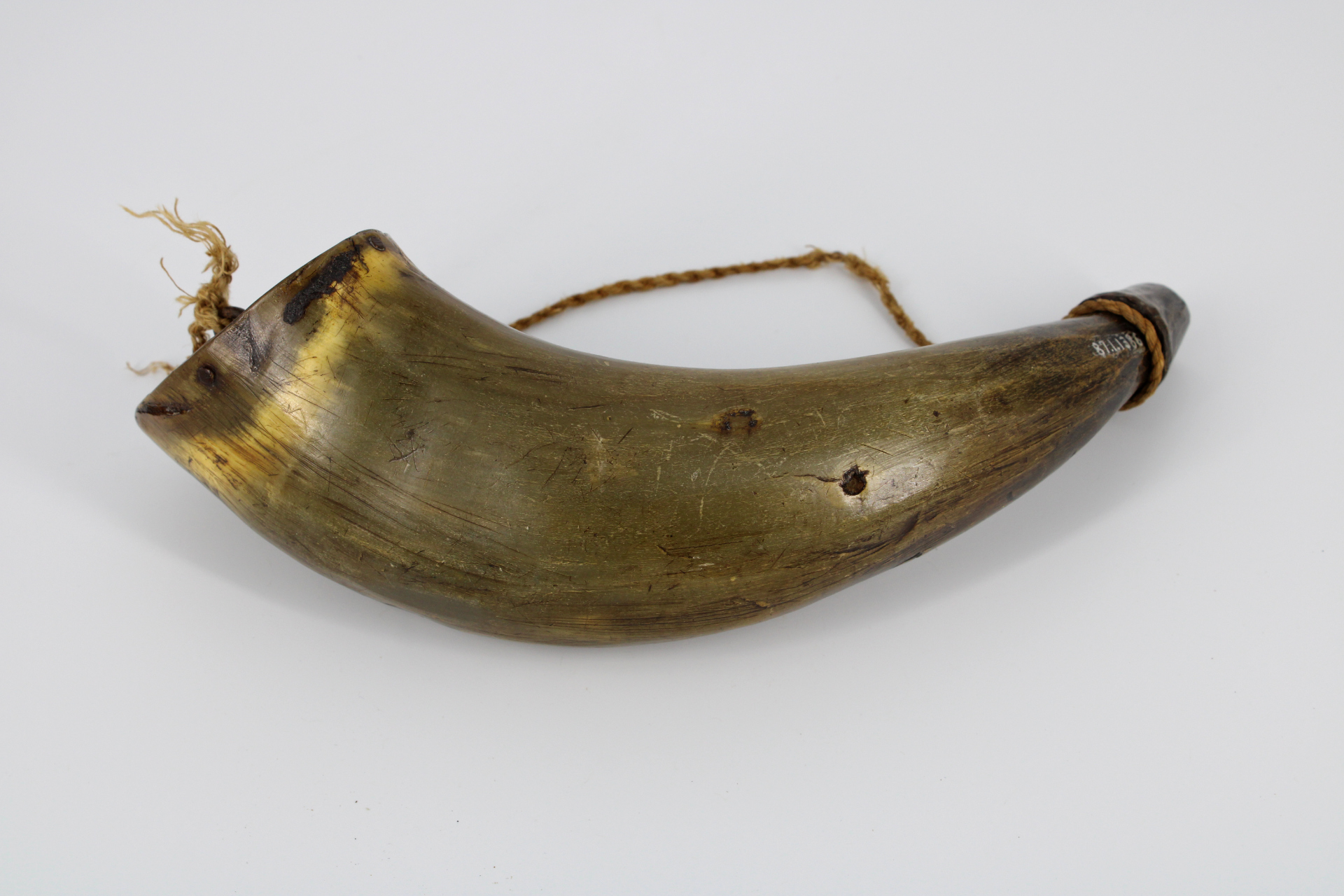
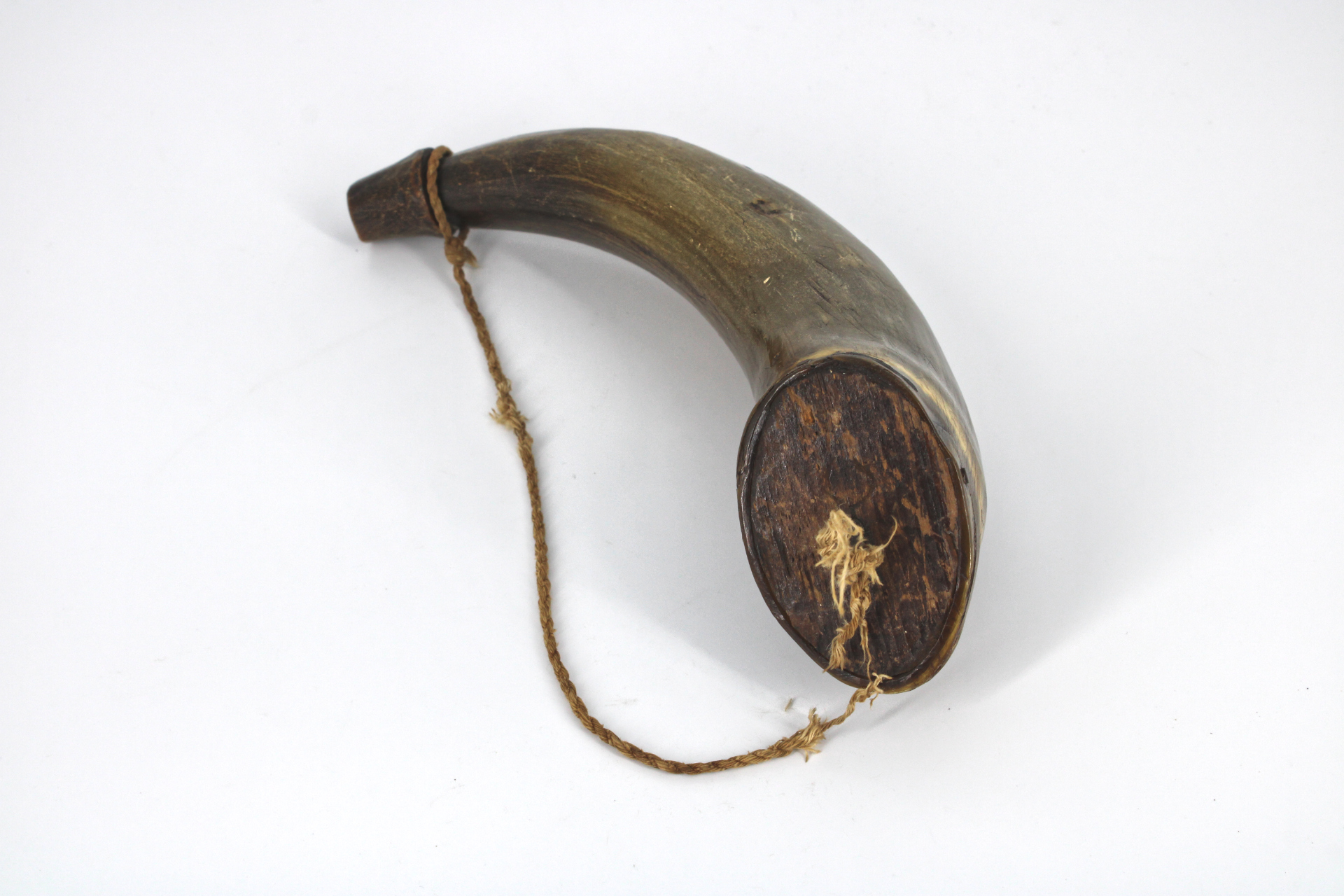
A cord and a wooden stopper accompany the object. Transliteration: J. C. or L. C. The horn is a bovine horn.
Value of the item
The object could have been used in two different contexts: hunting and defense.
First, the object reflects a skill traditionally associated with or practiced by the Acadian population, namely hunting. Hunting poultry (partridge, waterfowl) and deer is an integral part of Acadian life. These Acadians were probably inspired by traditional Mi'kmaq hunting techniques. Hunting is a complementary activity to trapping, fishing, and farming, and is still practiced today.
Similarly, the object bears witness to the development of Acadian and Gaspé society in general. Indeed, Acadians have frequently been subjected to disturbances, expropriations, deportations, and attacks of all kinds. The use of powder horns (or pear-shaped powder flasks or powder horns) attests to the use of firearms for defense.
This horn has the advantage of keeping the powder dry, as bovine horn is waterproof, impermeable, and shock-resistant. Hunters and soldiers were primarily concerned with keeping their powder dry.
First, the object reflects a skill traditionally associated with or practiced by the Acadian population, namely hunting. Hunting poultry (partridge, waterfowl) and deer is an integral part of Acadian life. These Acadians were probably inspired by traditional Mi'kmaq hunting techniques. Hunting is a complementary activity to trapping, fishing, and farming, and is still practiced today.
Similarly, the object bears witness to the development of Acadian and Gaspé society in general. Indeed, Acadians have frequently been subjected to disturbances, expropriations, deportations, and attacks of all kinds. The use of powder horns (or pear-shaped powder flasks or powder horns) attests to the use of firearms for defense.
This horn has the advantage of keeping the powder dry, as bovine horn is waterproof, impermeable, and shock-resistant. Hunters and soldiers were primarily concerned with keeping their powder dry.
Learn more
The Acadians suffered repeated disturbances that led to a major fragmentation of the population. During the Deportation of 1755, they were forcibly deported to various locations in North America and even Europe. In 1758, Wolfe's troops burned all the fishing stations in Baie-des-Chaleurs, and many Acadians living in the area or coming from other Acadian territories took refuge in a temporary village, Petite-Rochelle (1758-1760), which was burned during the Battle of Restigouche. Petite-Rochelle was located between Pointe-à-la-Garde and Pointe-à-la-Batterie. Following the battle, many Acadians took refuge on the shores of Baie-des-Chaleurs and founded Bonaventure (1760) and Carleton (1767). Other villages created by Acadians in Quebec between 1756 and 1757 include Saint-Gervais-de-Bellechasse, Saint-Grégoire, Saint-Jacques, Saint-Jean-sur-Richelieu, and other communities known as "Petites-Cadies." In this context of war, many Acadians were forced to take up arms.
Many powder horns are preserved by various museums, including the McCord Museum (https://collections.musee-mccord-stewart.ca/en/objects/450380/no-title), Pointe-à-Callières (https://www.patrimoine-culturel.gouv.qc.ca/rpcq/detail.do?methode=consulter&id=208290&type=bien), etc.
Powder horns may have originated with Indigenous peoples. They have been documented since the French regime in Quebec. According to the Ministry of Culture and Communications, "The powder horn is the companion of the musket, arquebus, rifle, and pistol. It contains the black powder used to fill the barrel. These fragments come from an object that usually contains the priming powder, which is in contact with the fuse or the spark from the flint and transmits the fire to the charge through the eye." (https://www.patrimoine-culturel.gouv.qc.ca/rpcq/detail.do?methode=consulter&id=208290&type=bien)
Among the notable powder horns owned by the Acadians is that of Jacques Leblanc, preserved by the University of Moncton in New Brunswick. According to the Encyclopédie du patrimoine culturel de l'Amérique française (Encyclopedia of French American Cultural Heritage), Leblanc was deported to Boston in 1755 and was one of the few exiled Acadians who returned to settle in Acadia after the Great Upheaval. He engraved the following inscription on the horn:
Jacques LeBlanc, son of François La Petitcotie. Made in Boston on March 23, 1762. (Translation of a Latin prayer): Pray for us, Holy Mother of God, that we may be worthy of Christ's promises. Jesus and Mary. Four years and nine months ago, my father died, in the year 1761 (62?). (http://www.ameriquefrancaise.org/fr/article-661/Mus%C3%A9e_acadien_de_l%E2%80%99Universit%C3%A9_de_Moncton.html)
Many powder horns are preserved by various museums, including the McCord Museum (https://collections.musee-mccord-stewart.ca/en/objects/450380/no-title), Pointe-à-Callières (https://www.patrimoine-culturel.gouv.qc.ca/rpcq/detail.do?methode=consulter&id=208290&type=bien), etc.
Powder horns may have originated with Indigenous peoples. They have been documented since the French regime in Quebec. According to the Ministry of Culture and Communications, "The powder horn is the companion of the musket, arquebus, rifle, and pistol. It contains the black powder used to fill the barrel. These fragments come from an object that usually contains the priming powder, which is in contact with the fuse or the spark from the flint and transmits the fire to the charge through the eye." (https://www.patrimoine-culturel.gouv.qc.ca/rpcq/detail.do?methode=consulter&id=208290&type=bien)
Among the notable powder horns owned by the Acadians is that of Jacques Leblanc, preserved by the University of Moncton in New Brunswick. According to the Encyclopédie du patrimoine culturel de l'Amérique française (Encyclopedia of French American Cultural Heritage), Leblanc was deported to Boston in 1755 and was one of the few exiled Acadians who returned to settle in Acadia after the Great Upheaval. He engraved the following inscription on the horn:
Jacques LeBlanc, son of François La Petitcotie. Made in Boston on March 23, 1762. (Translation of a Latin prayer): Pray for us, Holy Mother of God, that we may be worthy of Christ's promises. Jesus and Mary. Four years and nine months ago, my father died, in the year 1761 (62?). (http://www.ameriquefrancaise.org/fr/article-661/Mus%C3%A9e_acadien_de_l%E2%80%99Universit%C3%A9_de_Moncton.html)