
Download image

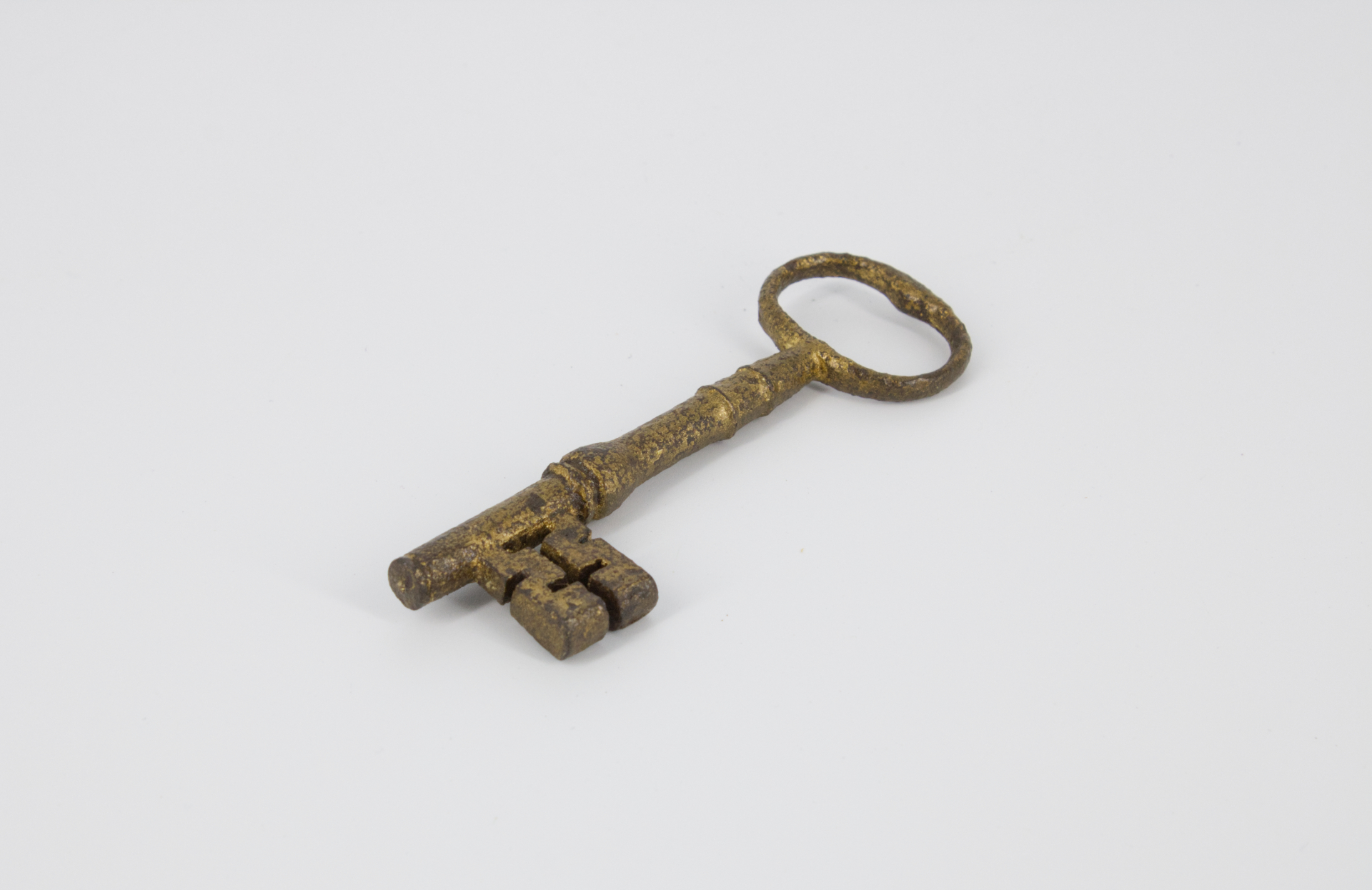
Key | Key | Apt’sqi’gn
Information about the object
Historical period
Unknown
Dimensions
Height: 3.20 cm. Width: 10.20 cm.
Classification
Tools and equipment -- Construction
Accession number
1987.1.1045
Division
Material culture -- Furnishings and decoration -- Home accessories
Collection
Evelyne Allard Landry
Donor
Evelyne Allard Landry
Category/theme
Description of the object
The brass key.
Value of the item
The object reflects a skill traditionally associated with or practiced by the Acadian population. In addition, the object reflects the work of blacksmithing, tinsmithing, and other metalworking, generally carried out by individuals rather than large companies. Blacksmiths work in construction, creating keys, horseshoes, etc., and most often serve local customers.
We have no information about this key or its manufacturer, but it is a so-called "skeleton" key.
We have no information about this key or its manufacturer, but it is a so-called "skeleton" key.
Learn more
Keys have ancient origins and have been in use for thousands of years. The earliest known keys were rudimentary objects, often made of metal or wooden rods, used to operate simple locks. Ancient Egyptian and Assyrian civilizations were already using locking devices and keys more than 4,000 years ago.
Over time, the techniques used to manufacture keys and locks have evolved. In ancient Rome, keys were often made of wrought iron and had more elaborate shapes. During the Middle Ages, the art of locksmithing developed in Europe, with increasingly complex and sophisticated locks and keys. Key styles varied according to era and region, reflecting the artistic and cultural influences of each period.
Today, keys continue to play an essential role in our daily lives for opening doors, padlocks, and other locking devices. With the advent of technology, traditional keys are increasingly being replaced by electronic locking systems and smart keys.
Over time, the techniques used to manufacture keys and locks have evolved. In ancient Rome, keys were often made of wrought iron and had more elaborate shapes. During the Middle Ages, the art of locksmithing developed in Europe, with increasingly complex and sophisticated locks and keys. Key styles varied according to era and region, reflecting the artistic and cultural influences of each period.
Today, keys continue to play an essential role in our daily lives for opening doors, padlocks, and other locking devices. With the advent of technology, traditional keys are increasingly being replaced by electronic locking systems and smart keys.