
Download image

Ida Leblanc handbag | Handbag | Munte’j
Information about the object
Historical period
c. 1925
Dimensions
Height: 45 cm. Width: 36 cm.
Classification
Decorative arts -- Textiles
Accession number
1987.1.1459
Division
Clothing and accessories -- Accessories -- Personal accessories
Collection
Evelyne Allard Landry
Donor
Evelyne Allard Landry
Category/theme
Description of the object
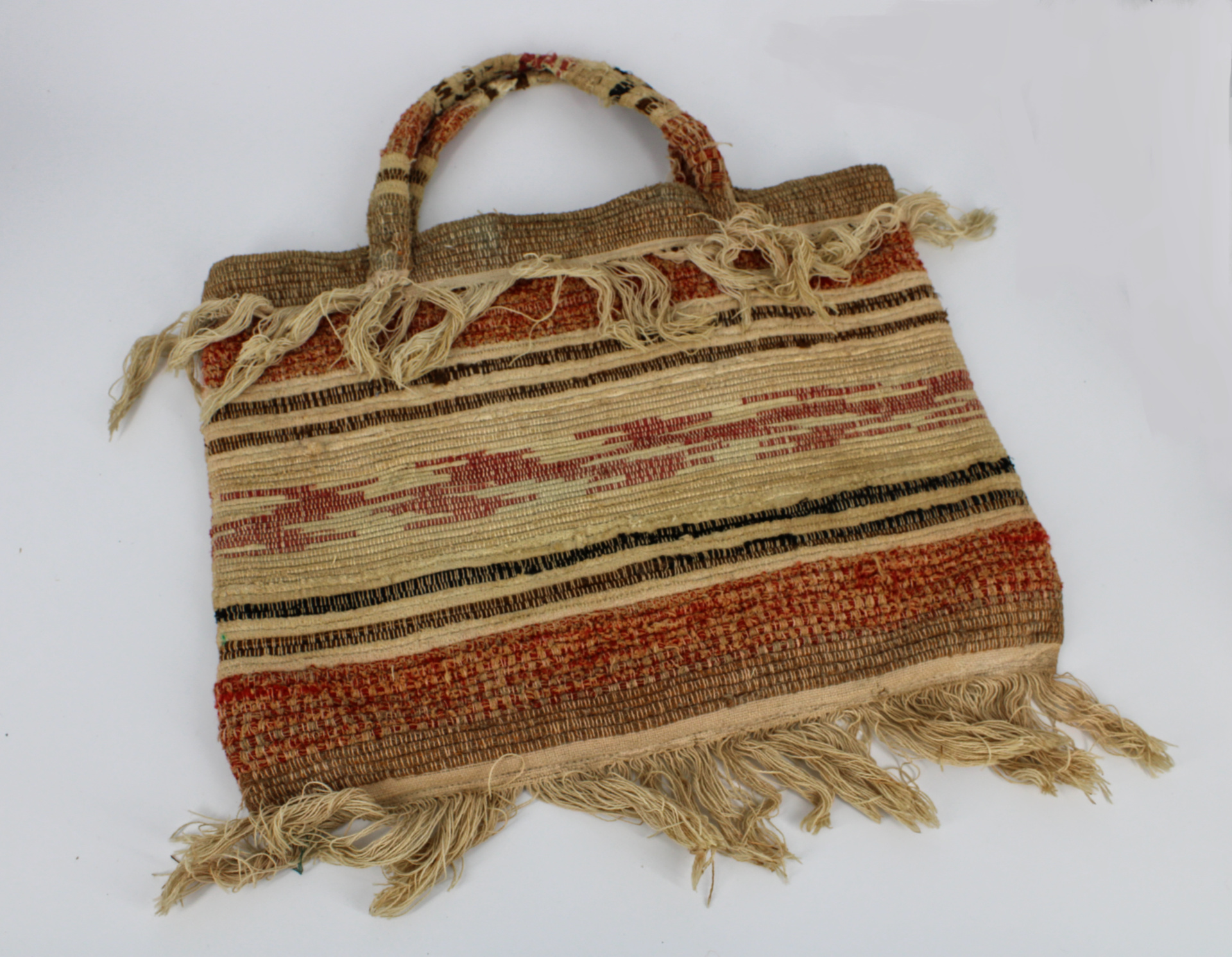
Work by Ida Leblanc, wife of Joseph-Auguste Allard, captain (and son of Lazare Allard), circa 1925. Loom-woven bag. Autumn colors. Two handles, fringe at the bottom and along the top edge. Cotton. Autumn colors.
Value of the item
The object bears witness to a skill traditionally associated with or practiced by the Acadian population. More specifically, the object bears witness to the skill associated with textile processing by Acadian women, including sewing, weaving, embroidery, knitting, etc.
The object also reflects an Acadian family from Carleton, the Allard family, famous for its many generations of pilots, and the Leblanc family, still well represented in the Petites-Cadies region of Quebec and in Acadian territory.
The object also reflects an Acadian family from Carleton, the Allard family, famous for its many generations of pilots, and the Leblanc family, still well represented in the Petites-Cadies region of Quebec and in Acadian territory.
Learn more
Joseph-Auguste Allard (1872–1963) was the son of Lazare Allard, captain (1841–1924) and pilot of the Dalhousie–Miguasha ferry. The ferry service was officially inaugurated in 1890 by Lazare Allard and his steamboat, the Florence. His sons took over the business, including François (known as Frank) Allard and Joseph Auguste Allard, who kept a logbook documenting his travels between 1900 and 1960, also preserved by the Musée acadien du Québec. For more information, see the article "The Miguasha-Dalhousie ferry: 1890-1996" in Gaspésie Magazine, August-November 2021, pp. 15-17.

Photo by Rachel Allard. Ida is on the far right of the image.
The Weaving is a type of craft and textile processing that has become popular. in Quebec and the Maritime provinces between the 17th century and the first half of the 20th century, but it was already practiced by First Nations long before colonization. One of the most popular looms became the Jacquard loom, which gained popularity in the early 19th century. Hooked rugs are one of the typical Acadian crafts. Furthermore, cataloguing is both an indigenous and Quebec practice, with the first written references dating back to 1613..
Photo by Rachel Allard. Ida is on the far right of the image.
The Weaving is a type of craft and textile processing that has become popular. in Quebec and the Maritime provinces between the 17th century and the first half of the 20th century, but it was already practiced by First Nations long before colonization. One of the most popular looms became the Jacquard loom, which gained popularity in the early 19th century. Hooked rugs are one of the typical Acadian crafts. Furthermore, cataloguing is both an indigenous and Quebec practice, with the first written references dating back to 1613..